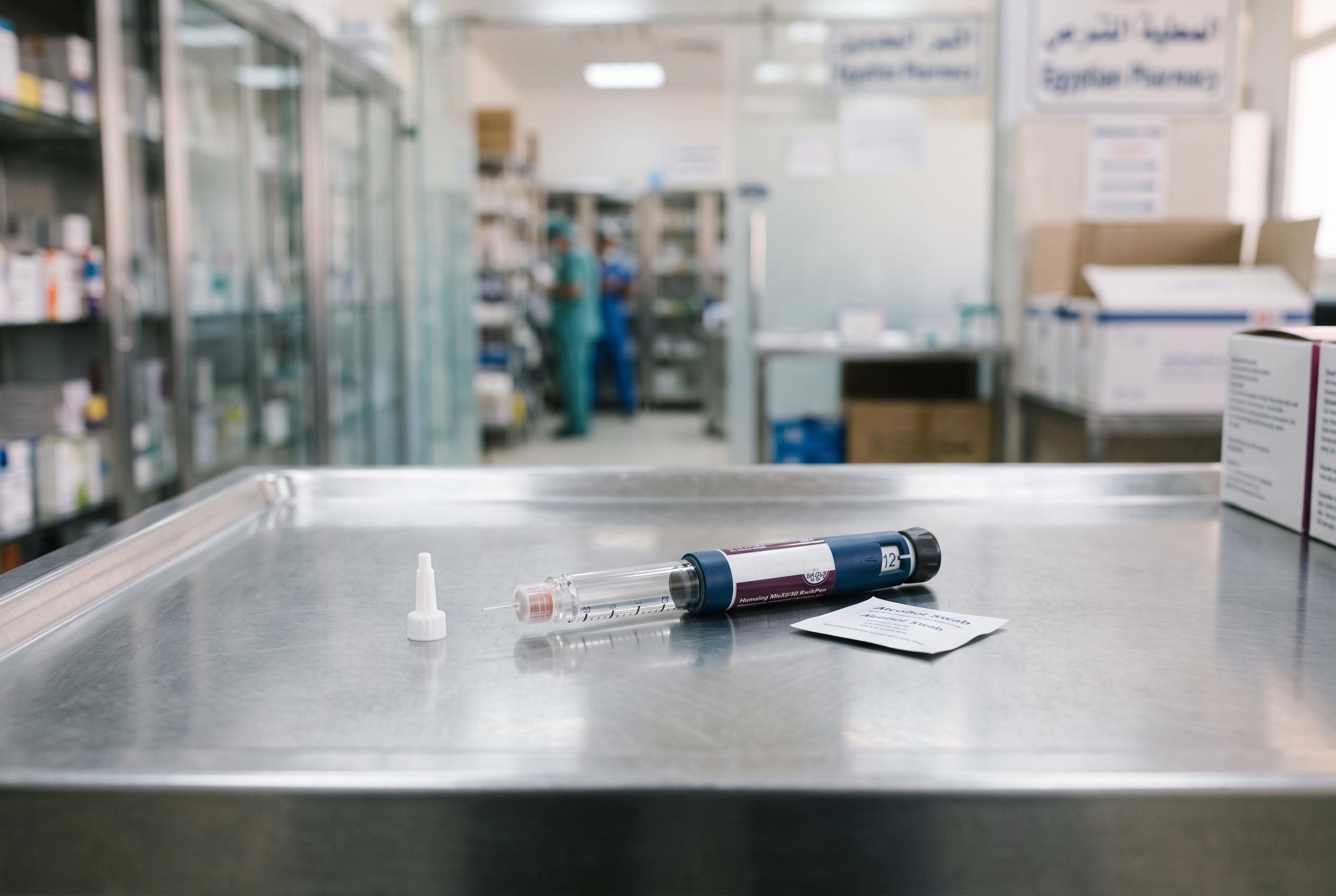

Egypt’s Health Ministry has responded to criticism over insulin imports, emphasising local manufacturing capabilities and distinguishing between brand shortages and overall drug availability to reassure diabetic patients amid ongoing debates on medicine imports.
Egypt’s Health Ministry has moved to calm criticism over remarks by Health Minister Khaled Abdel Ghaffar on insulin imports, saying the public debate had blurred an important distinction between a shortage of a specific brand and a broader lack of the drug itself.
In a statement posted on the ministry’s Facebook page on Monday evening, Abdel Ghaffar said claims of a general insulin shortage required more careful scrutiny. He said locally produced insulin is available and meets the needs of the Egyptian market, while occasional gaps are usually linked to the unavailability of one commercial brand rather than the absence of the active ingredient or treatment.
He said Egyptian-made insulin is produced from raw materials supplied by major international insulin manufacturers, including Eli Lilly of the US and Novo Nordisk of Denmark, before being manufactured in Egyptian plants under approved regulatory standards. He added that choosing an imported brand when a registered local equivalent exists is a personal preference, not evidence that the state has failed to provide treatment.
The minister also argued that importing the finished product in foreign currency, when Egypt has domestic production capacity and registered alternatives, is not the most efficient option for drug security or for sustaining supply. He said equivalent medicines contain the same active ingredient and formulation as the reference product, though the brand name and price band may differ.
Abdel Ghaffar said four Egyptian companies produce insulin equivalents, widening patient choice and strengthening the state’s ability to cover local demand. The ministry said treatment is available through health insurance and state-funded care schemes, subject to medical eligibility rules.
The explanation comes after Abdel Ghaffar’s television comments on Sunday drew criticism for their blunt tone. He had said he could not import insulin when Egypt already has four factories making it, and that anyone wanting an imported version could buy it from a pharmacy at their own expense. He said he wanted to save foreign currency and encourage local industry if it matched the quality of imported products.
The latest statement follows a series of similar assurances from the minister over recent years. In July 2023, he said some imported diabetes medicines might be scarce but local alternatives were available. In April this year, he said shortages in some imported drugs could occur at times but that local substitutes remained on hand, with the health ministry, the drug authority and the Central Bank coordinating supply. In November 2025, he dismissed reports of an insulin shortage and said three local companies were producing the medicine. In August 2024, he said the ministry was supplying insulin to 1.5 million people through the Health Insurance Authority and that more shipments were due to arrive quickly after a temporary squeeze.
Disclaimer: This content is for informational purposes only and is not intended to be a substitute for professional medical judgment, advice, diagnosis, or treatment.