

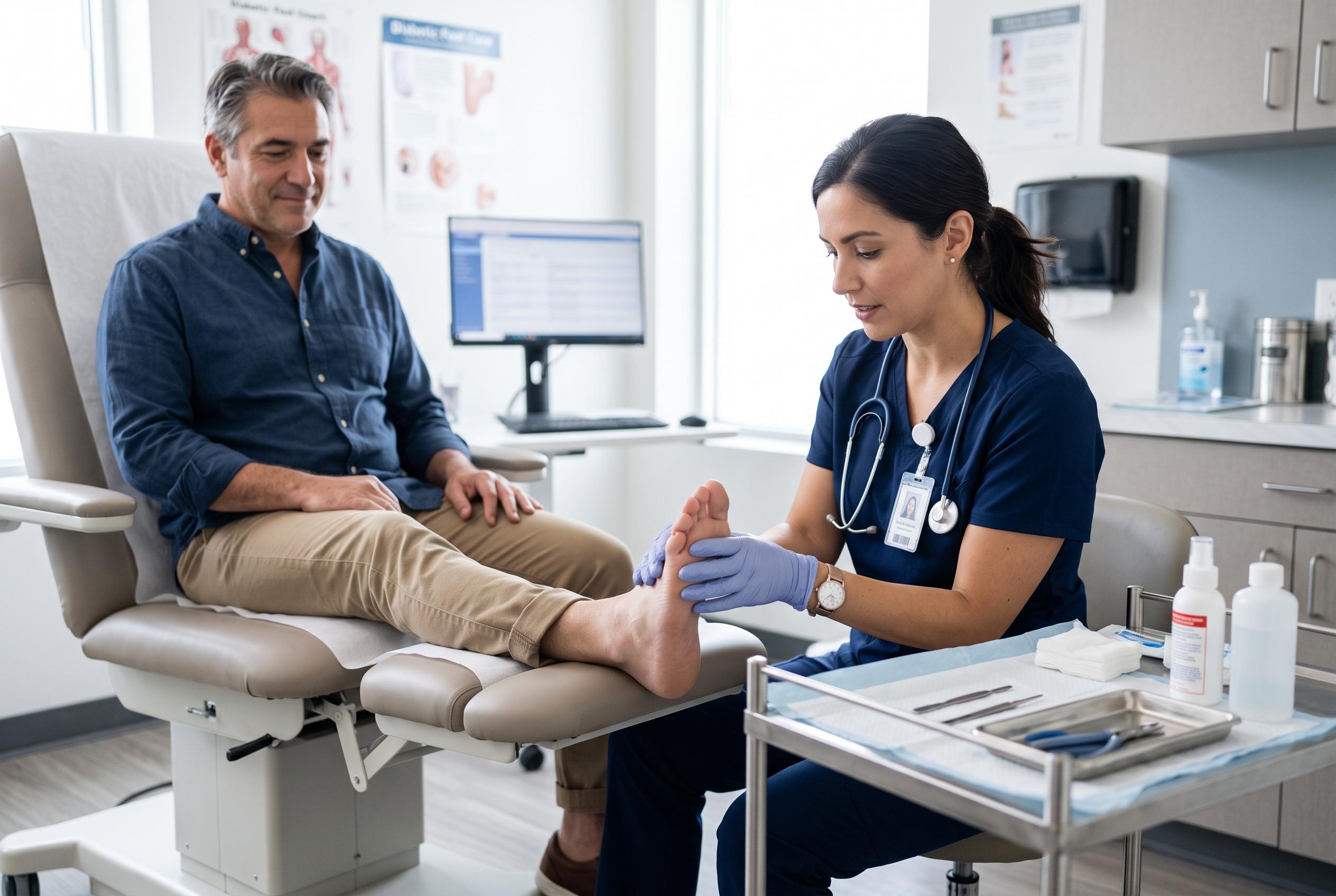

A national registry is giving Australian services a clearer view of diabetic foot care, while highlighting the importance of consistent data, case-mix adjustment and sustained investment.
Australia’s new diabetic foot registry is offering something the field has long needed: a clearer way to see who is being treated, how quickly care begins, and what happens next. In the International Wound Journal, Stephen Twigg, Peter Lazzarini and colleagues describe the Australian Diabetes Foot Registry as a national quality system built to turn everyday clinic activity into usable evidence for care improvement.
The registry was established in 2020 under the Australian Diabetes Society and the National Association of Diabetes Centres, with St Vincent’s Hospital Sydney serving as sponsor and data custodian. It follows people with active foot ulcers or active Charcot neuro-osteoarthropathy who attend high-risk foot services. By the end of June 2025, it had enrolled 10,919 people across 13,150 care episodes and 22,383 ulcerations, with 49 sites across 37 services having completed implementation and 42 sites still collecting data. Mean service-level capture of eligible patients reached 80% in 2024-25, underscoring both the scale of the effort and the importance of keeping denominators straight.
That emphasis on measurement echoes long-standing arguments from wound-care researchers in the United States. Caroline Fife and colleagues have repeatedly warned that healing rates can look better or worse depending on who is counted, when follow-up starts and how losses to follow-up are handled. In a 2018 paper in the same journal, they reported that 30.5% of diabetic foot ulcers in their registry analysis healed by 12 weeks, after excluding one-visit wounds and those still in service. More recent data from the Diabetic Foot Consortium’s Open Wound Master Protocol found 26% of diabetic foot ulcers healed by week 12, reinforcing the need for cautious interpretation of headline figures.
Australia’s registry is not just a tally. The paper describes a common data dictionary, support for participating teams, annual benchmarking reports and tools that allow individual services to examine their own performance. It already stratifies key measures by baseline ulcer severity using SINBAD, a standard ulcer-severity score, and the authors say fuller risk-adjusted benchmarking is a next step. That matters because without adjustment for case mix, comparisons between services can be misleading rather than useful.
The Australian experience also shows how fragile registries can be without sustained infrastructure. Two sites stopped collecting data and five paused because of staffing or technical problems, a reminder that quality measurement depends on protected time, reliable systems and continuing support. The registry’s design may be scalable, but its success still relies on people and money, not just enthusiasm.
Several other countries are building similar foundations. England and Wales operate the National Diabetes Foot Care Audit, which benchmarks specialist foot services against National Institute for Health and Care Excellence guidance. Sweden’s RiksSår registry tracks hard-to-heal wounds, including diabetic foot ulcers, while Belgium’s IQED-Foot audit provides feedback to multidisciplinary clinics. In the United States, the U.S. Wound Registry and the STEADY study are adding to the evidence base, but they also illustrate how varied data collection can be across systems and wound types.
For Australia, the registry appears to be doing what many services say they want but few have managed to sustain: making measurement part of care rather than an extra task. The larger lesson is broader still. If health systems want to reduce amputations, improve healing and understand recurrence, they first need a shared way to count what is happening. The Australian model suggests that this is possible, but only if the field is prepared to treat data collection as core clinical work rather than an optional add-on.
Disclaimer: This content is for informational purposes only and is not intended to be a substitute for professional medical judgment, advice, diagnosis, or treatment.



