

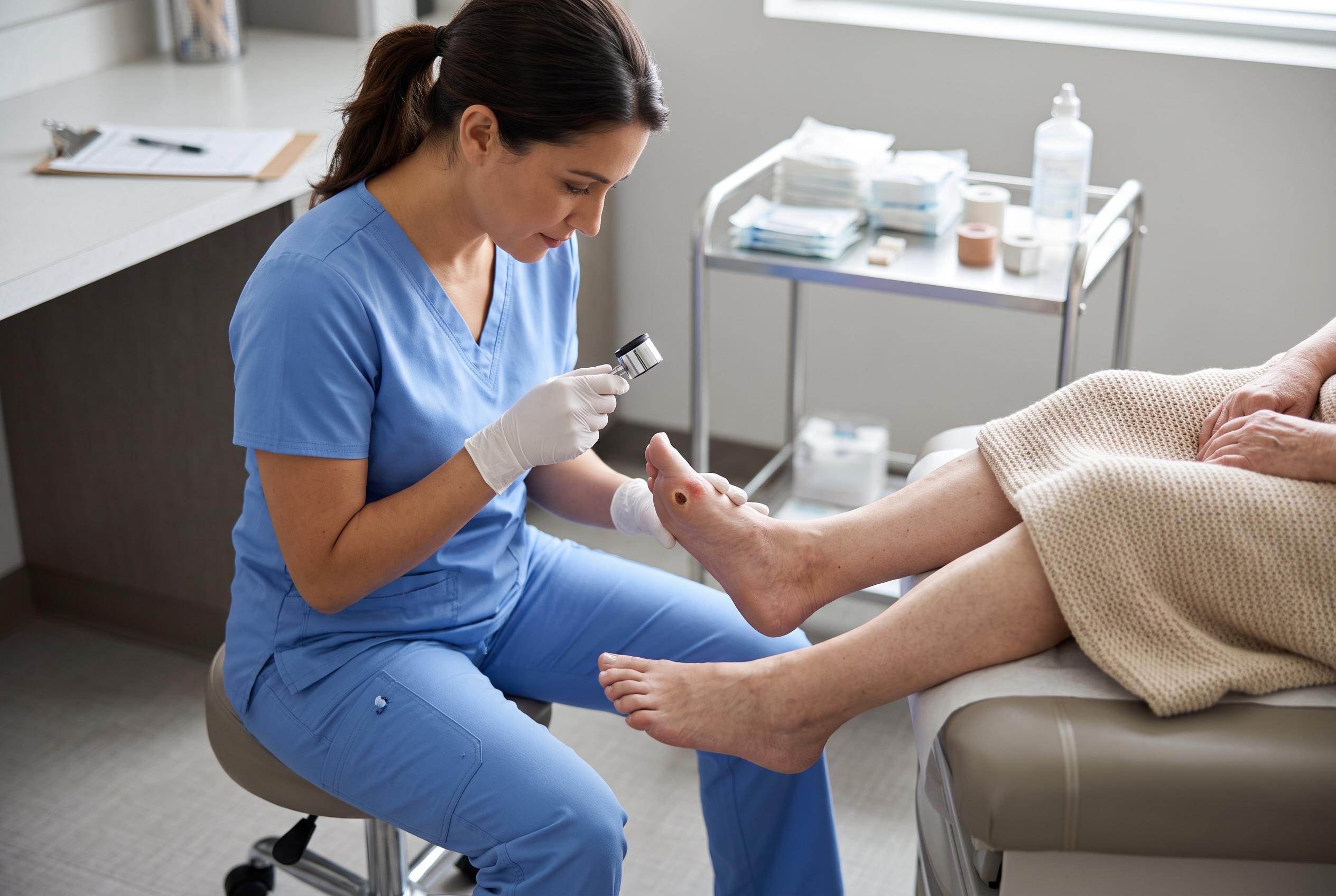

Emerging AI tools are revolutionising assessment and treatment of diabetic foot ulcers, but experts warn that standardisation and ethical considerations remain key hurdles before widespread clinical adoption.
Artificial intelligence is beginning to reshape the way diabetic foot ulcers are assessed, monitored and treated, according to a review published by Dove Press. The paper argues that the shift matters because diabetic foot ulcers remain one of the most serious long-term complications of diabetes, with a lifetime risk estimated at 19% to 34% and a global prevalence of about 6.3%, while recurrence after treatment remains stubbornly high. Related reviews in the National Library of Medicine and Diabetes Care also note the heavy clinical toll, including substantial amputation risk, reduced quality of life and major costs for health systems.
The review says the strongest immediate uses for AI are in image-based assessment and patient self-management. In practice, that means machine learning models can help segment wound borders, distinguish granulation, slough and necrotic tissue, and estimate wound size more consistently than manual inspection alone. The paper highlights mobile applications that let patients photograph ulcers at home and receive automated feedback, while clinicians can review the same images remotely. It also points to wearable sensors, including temperature monitors and pressure-sensitive insoles, as a way to spot inflammation or dangerous pressure patterns before a wound worsens.
Beyond assessment, the authors describe growing interest in AI-assisted dressings and treatment systems. Some research teams are using machine learning to speed up the design of materials that are more likely to support healing, while others are building smart dressings that can measure pH, temperature, moisture and inflammatory signals. More advanced closed-loop systems aim not only to sense changes but also to respond to them, such as releasing drugs or growth factors when a wound environment suggests infection or poor healing. The review treats these approaches as promising, but still experimental.
The paper also says predictive modelling is becoming more useful in diabetic foot care. Machine learning systems can combine wound images, laboratory results, medical history and patient demographics to estimate whether an ulcer is likely to heal. That matters because it may help clinicians tailor treatment intensity, decide how quickly to review a patient and identify those most at risk of poor outcomes. The review says support vector machines and long short-term memory networks have both shown encouraging performance, although it stresses that these tools still need stronger prospective testing in real clinical settings.
A further step, the authors argue, is the creation of clinical decision support systems that combine guidelines, patient data and AI outputs into recommendations doctors can trust and use. But the review is clear that the field still faces major barriers. Most studies are based on small, single-centre datasets, wound images are collected under inconsistent conditions, and many models remain difficult to interpret. There are also unresolved questions about liability, data security and how well these systems will fit into busy clinical workflows. Other reviews echo those concerns, saying the evidence base remains uneven and that disparities in access could widen if new tools reach only better-resourced centres.
For now, the review’s central message is that AI is moving diabetic foot ulcer care away from a model based largely on experience and towards one built around data, prediction and continuous monitoring. But the authors also caution that technical promise is not the same as clinical readiness. Standardised datasets, explainable models, human oversight and proper implementation studies will be needed before AI can be considered a routine part of diabetic foot care.
Disclaimer: This content is for informational purposes only and is not intended to be a substitute for professional medical judgment, advice, diagnosis, or treatment.



