

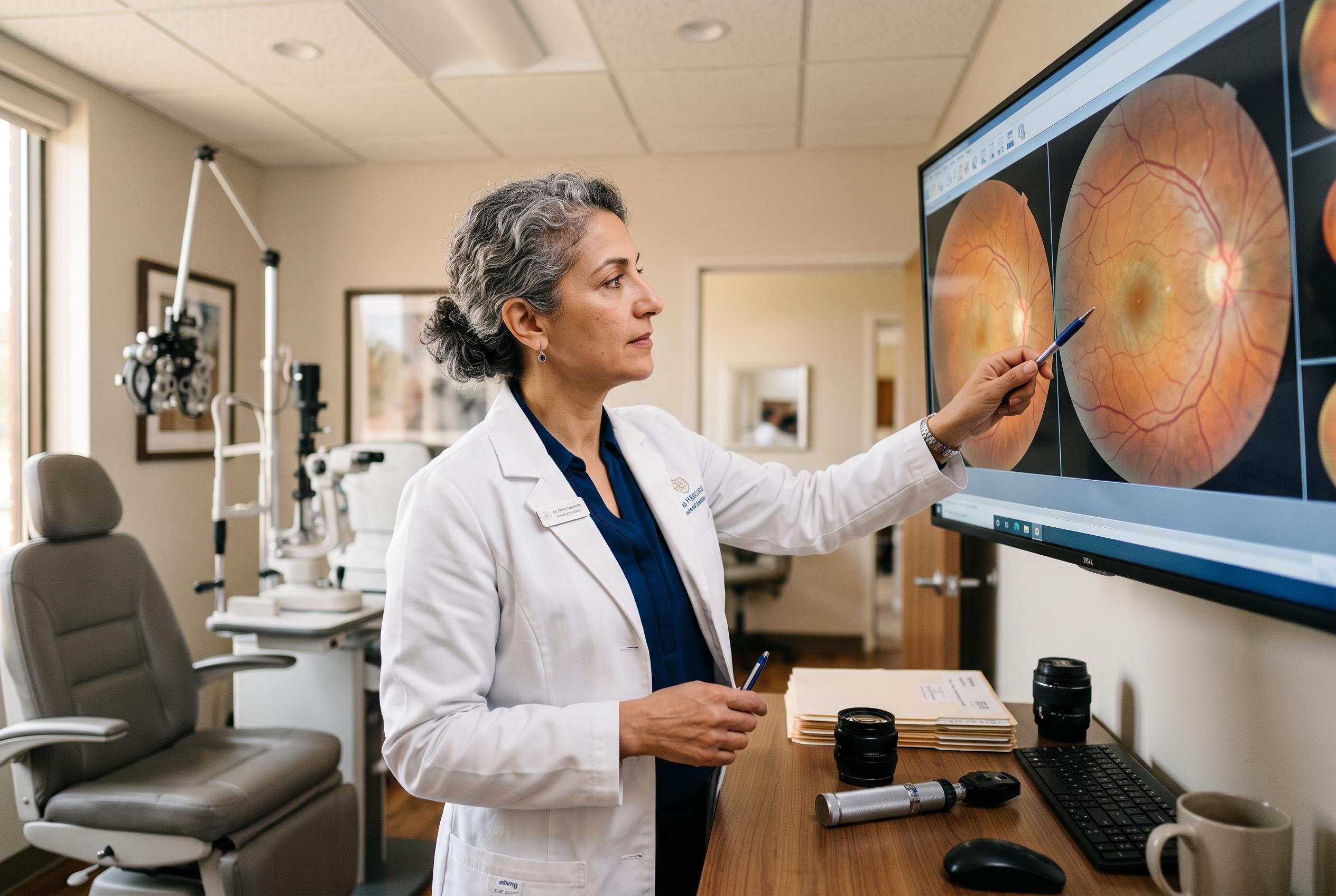

A review finds retinal scans work best when combined with clinical data, but small studies, inconsistent definitions and limited external validation are holding back clinical use.
A systematic review published in the Wiley journal article suggests that deep learning models trained on retinal images could help identify diabetes-related kidney disease, especially when eye scans are combined with routine clinical data. The paper examined six studies and found that hybrid systems, which blended retinal images with information such as kidney function markers and diabetes history, tended to outperform models that relied on a single input type. Yet the authors also caution that the evidence base is still small, uneven and too heterogeneous to support firm clinical conclusions.
Diabetes-related kidney disease is one of the most serious complications of diabetes and a major driver of end-stage kidney failure. Because the condition often develops silently, researchers have been looking for ways to detect it earlier than standard tests alone can manage. The review notes that current screening usually depends on estimated glomerular filtration rate, or eGFR, and urine albumin-creatinine ratio, but these measures can miss early microvascular change. That has made the retina attractive as a possible window into kidney health, given the shared vascular features of the eye and kidney.
Across the studies included in the review, performance was strongest for hybrid models that brought together retinal imaging and clinical variables. One pooled analysis of the cross-sectional studies found an internal-validation area under the curve of 0.88, with sensitivity of 0.80 and specificity of 0.81, although the authors stress that the estimate rested on only three studies and showed very high heterogeneity. Individual papers also suggested that retinal images alone could carry useful signal. In one large Chinese study, for example, a model built with weakly supervised contrastive pretraining achieved an internal AUC of 0.84 for retinal images alone and 0.85 for the hybrid version, with external validation across 10 cohorts showing AUCs in the 0.79 to 0.83 range. A separate longitudinal study in South Korea reported an internal AUC of 0.808 for predicting five-year risk, but that figure fell to 0.722 when tested in UK Biobank.
The review also highlights how much the field still depends on inconsistent definitions of disease. Some studies defined diabetes-related kidney disease as eGFR below 60 mL/min/1.73m2, while others required repeated abnormal results, used a stricter eGFR threshold, or incorporated albuminuria as an additional criterion. Sample sizes ranged from just 225 participants in one single-centre Indonesian study to more than 121,000 in a Chinese dataset, and only four studies performed external validation. The authors say that this matters because performance generally dropped when models were tested outside the data on which they were developed, a sign that calibration and generalisability remain unresolved. A previous meta-analysis of machine learning for diabetic kidney disease, published in the literature recently, also reported strong pooled discrimination but warned that heterogeneity and weak external validation limit confidence in the results, reinforcing the broader message that promising AUCs alone are not enough.
The review’s main conclusion is cautious but optimistic: deep learning may eventually help screen for diabetes-related kidney disease using a non-invasive test already familiar from diabetic eye care, but the evidence is not yet mature enough for routine use. The authors argue that future studies need standardised outcome definitions, larger and more diverse cohorts, better external validation and clearer reporting of calibration, not just discrimination. They also say interpretability will matter if these tools are to be trusted in practice, since clinicians will need to understand which retinal features are driving a prediction and how much weight to give an algorithm in real-world screening pathways.
Disclaimer: This content is for informational purposes only and is not intended to be a substitute for professional medical judgment, advice, diagnosis, or treatment.



