

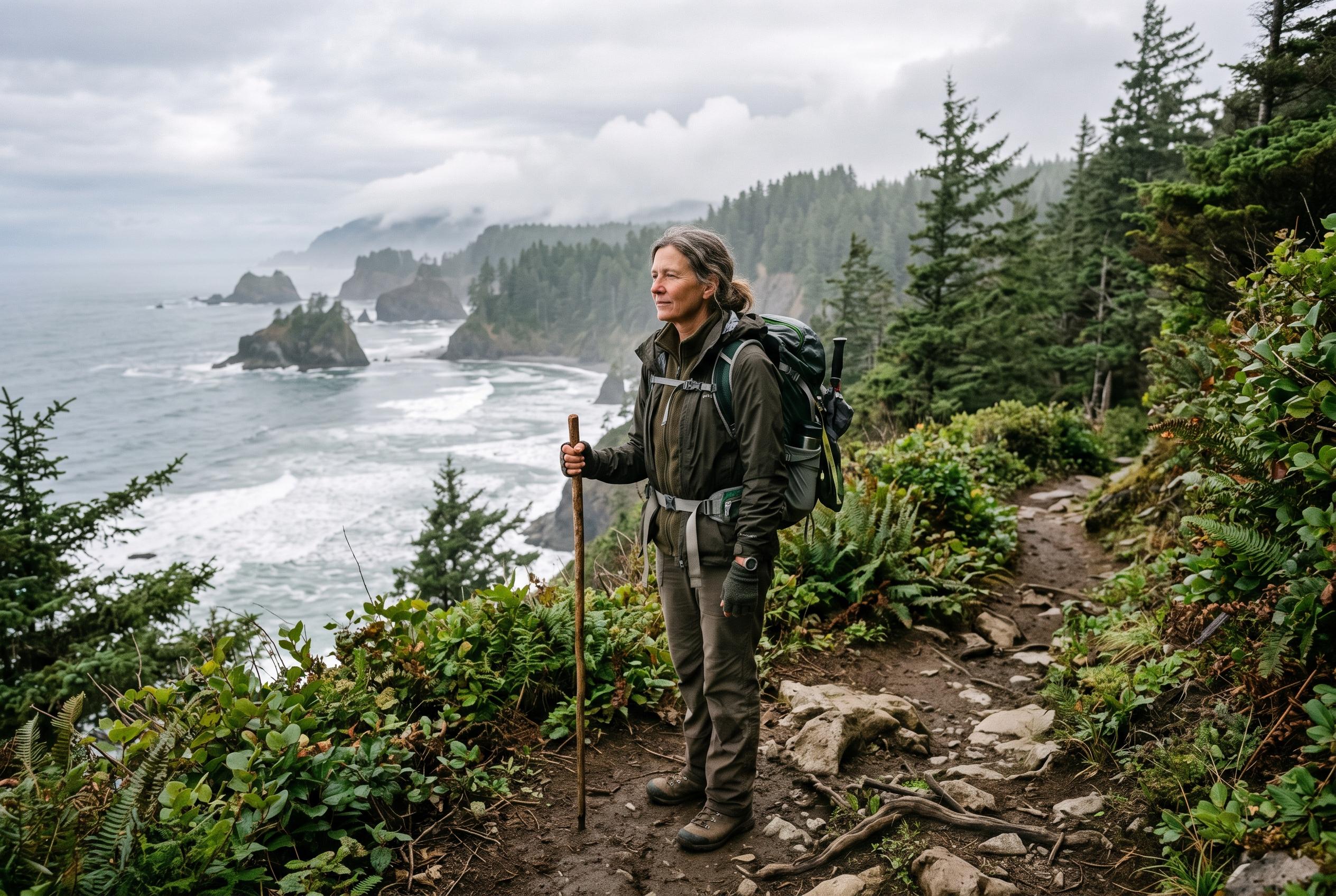

After a diagnosis threatened to redefine her future, Brandy “Pumbaa” Sales found a different way forward on Washington’s Olympic coast , through preparation, attention and self-acceptance.
Brandy “Pumbaa” Sales uses a backpacking trip in Olympic National Park to tell a much larger story about diagnosis, adaptation and self-acceptance. Writing in the form of a letter to her younger self, she recalls the shock of learning in August 2013 that she had diabetic retinopathy, a diabetes-related eye disease that can lead to serious vision loss if it is not found and treated early. The piece turns that moment into a reflection on how a life can change without becoming diminished.
Sales describes the fear of facing a future she could not yet see, both literally and emotionally. The diagnosis came just weeks after she left a corporate marketing job to start her own video production company while raising two young children. Her account mirrors the guidance of the Mayo Clinic and Johns Hopkins Medicine, both of which stress that diabetic retinopathy affects the retina’s blood vessels, that regular dilated eye examinations are essential and that treatments may include injections, laser therapy or surgery depending on severity.
The strongest thread in the piece is not illness alone, but adjustment. Sales writes about learning to navigate the world differently, especially outdoors, where distant trail markers and changing light can make simple decisions harder. That idea sits alongside a broader truth found in anxiety-management guidance from Healthline, Cleveland Clinic and Simply Psychology: coping is often less about eliminating anxious thoughts than about managing them. Breathing exercises, progressive muscle relaxation, mindfulness, journalling and cognitive-behavioural therapy are all commonly recommended tools, though experts note that short-term calming techniques work best when paired with longer-term treatment.
On the trail, that balance between vigilance and perspective becomes the heart of the story. Sales describes thinking through every possible hazard on a coastal route where tides can cut off access, then recognising that the same mental habit can become a strength when it is channelled into preparation rather than paralysis. The article presents anxiety not as something to be glorified, but as a force that can either narrow life or help organise it.
The day itself provides a sequence of small victories: reaching ancient petroglyphs at Wedding Rocks, arriving at Cape Alava with time to spare, sitting quietly by the water and choosing to notice birds when distant whales are out of clear view. Those moments give the essay its emotional centre. Sales suggests that people often miss what is in front of them because they are preoccupied with what they fear losing or what they cannot yet reach.
By evening, the trip becomes less about endurance than perspective. Sales frames her vision loss and her anxiety as parts of a life that still includes travel, work, family, beauty and surprise. The closing message is plain and generous: a person does not need perfect clarity before moving forward. In that sense, the article is as much about resilience as it is about disability, and as much about attention as it is about sight.
Disclaimer: This content is for informational purposes only and is not intended to be a substitute for professional medical judgment, advice, diagnosis, or treatment.



