

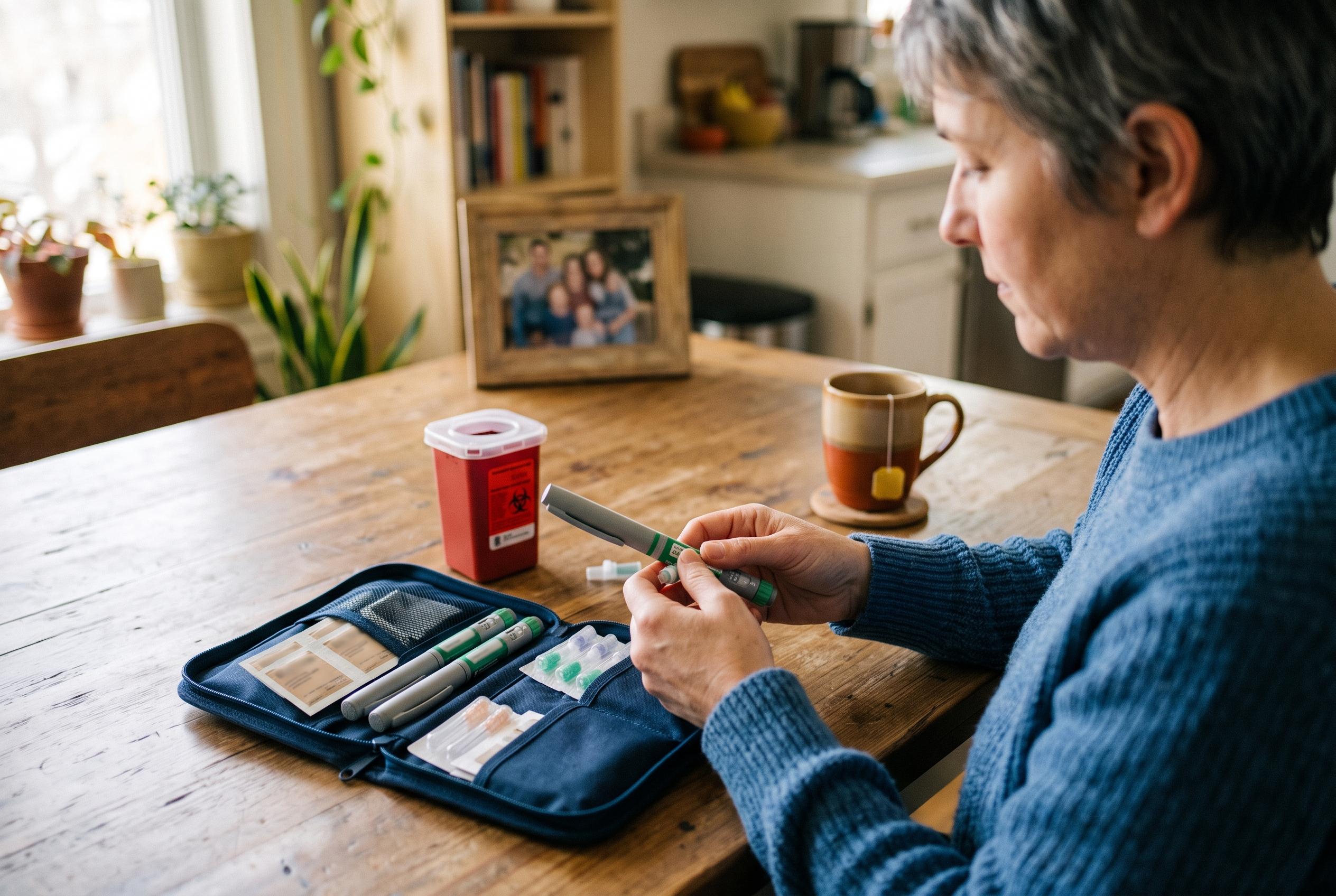

Storage, travel, injection technique, disposal and privacy can determine whether a long-term treatment remains manageable in everyday life.
Starting a long-term medicine is usually framed as a medical decision: what it treats, why it matters and which side-effects deserve attention. Much less time is spent on the ordinary realities that shape whether a treatment fits into daily life. Storage, travel, timing, disposal and disclosure can be just as important as dosage, because a therapy that looks straightforward on paper can become burdensome once it meets the routines, stress and unpredictability of real life.
That practical gap matters across a wide range of treatments, from insulin and biologics to fertility medicines and hormone therapy. Injectable testosterone is one example where patients may need clear instruction on supplies, safe administration and injection sites, depending on the formulation and the clinician’s advice. The broader lesson is that the clinical explanation is only half the job. People also need to know how to make the treatment work at home, week after week, without turning it into a source of anxiety.
Storage is one of the first places where that reality appears. Some medicines require refrigeration, some can be kept at room temperature for a limited period after opening and some have narrow stability windows once they have been punctured or removed from cold storage. Medical News Today has noted that Dupixent pens, for example, should be kept in the refrigerator before use and can be stored at room temperature only for a limited time afterwards. Xolair has similar refrigeration requirements, according to the same publication. That kind of guidance is easy to miss until someone is packing for a trip or discovers a dose has spent too long in heat or outside its recommended range.
Travel adds another layer of difficulty. Healthline advises people taking Ozempic to keep it in carry-on luggage, use an insulated travel case or cooler and be prepared to explain the medication at airport security. The same practical concerns apply more widely to injectable treatments: if a medicine needs to stay cold, it helps to plan in advance for hotel rooms, long journeys and days away from home. What matters most is knowing the rules before an emergency or a delayed flight leaves someone guessing.
The physical act of injecting is another part of treatment that is often reduced to a quick demonstration. The Centers for Disease Control and Prevention says safe injection practice depends on aseptic technique, fresh sterile needles and syringes for each use and careful handling of vials to avoid contamination. For patients learning to self-inject, MedlinePlus offers detailed guidance on intramuscular injections, including how different sites are located and why rotating them matters over time. Repetition can make the routine feel easier, but it also makes good technique more important, not less, because the same spot used again and again can become sore or irritated.
Disposal is another issue that is often overlooked until it becomes a problem. The Food and Drug Administration says used sharps should go straight into an appropriate sharps container and should not be thrown into ordinary rubbish. The CDC likewise advises securing unused or expired prescription medicines and using take-back programmes where available. That advice is not simply bureaucratic caution. Loose needles can injure family members, cleaners and sanitation workers, and medication waste can create risks if it is left within reach of children or pets.
There is also the quieter question of who needs to know. Some people are open about a long-term treatment; others prefer privacy. Either choice can work, but both require a plan. That may mean thinking ahead about where medicine is stored at work, how to handle a dose while travelling with other people or whether a trusted contact should know enough to help in an emergency. The most useful systems are often the simplest: a fixed storage place, a backup supply kit, a reminder that does not rely on memory and a clear plan for missed doses agreed with a clinician in advance.
Disclaimer: This content is for informational purposes only and is not intended to be a substitute for professional medical judgment, advice, diagnosis, or treatment.



