

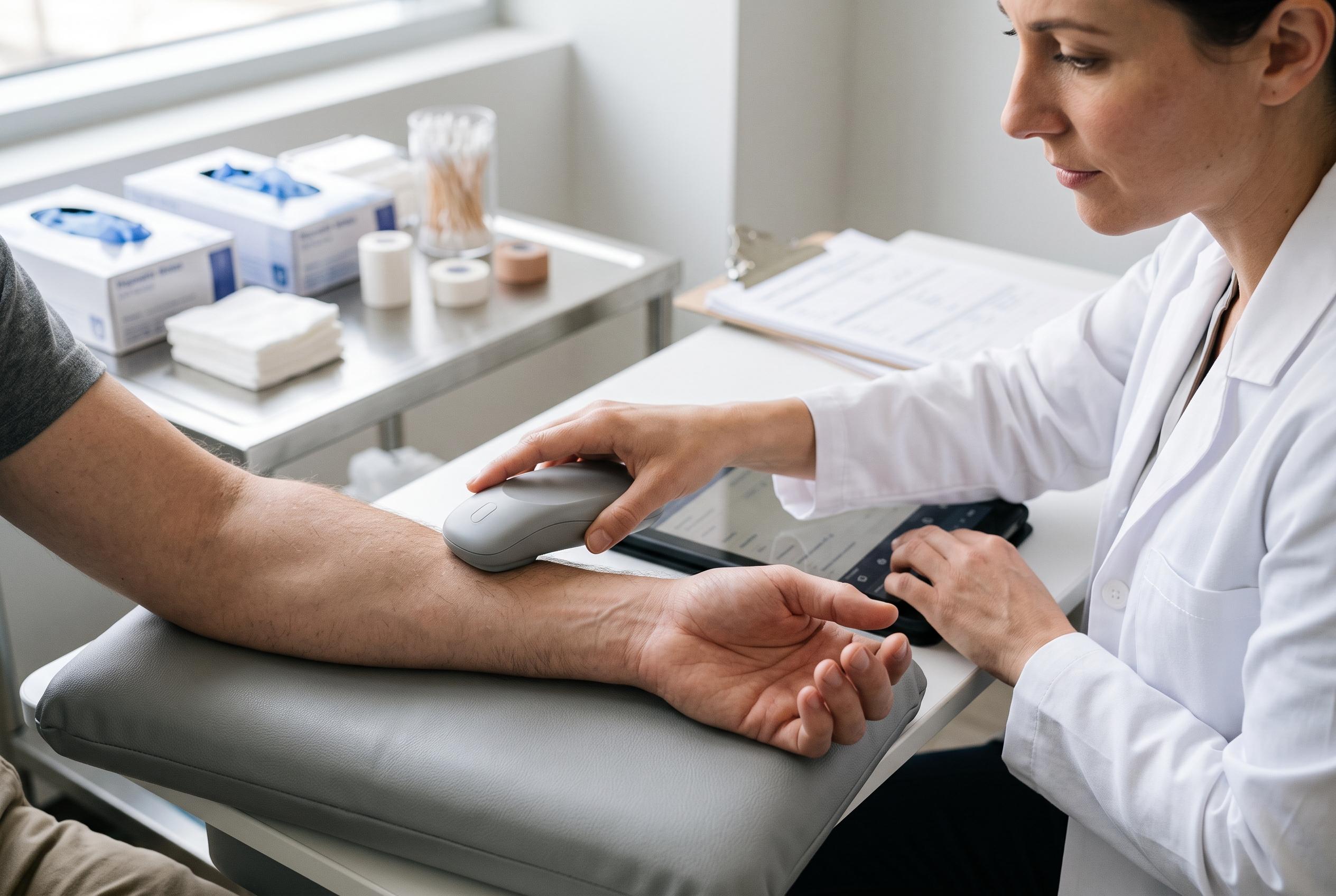

Huawei announces a new method to measure blood glucose without finger-pricks, but the technology faces scientific and regulatory challenges before reaching consumers.
Huawei has said it has developed a way to measure blood glucose without a finger-prick after four years of research, but the company has disclosed no launch date, product format or medical clearance. The announcement was made by He Gang, who leads Huawei’s consumer business, during a recruitment presentation at Peking University on 25 September 2026, according to Frandroid and Ithome. Huawei said the technology is now considered “acceptable” and “industrialisable”, suggesting it could be ready for manufacturing, but it has not shown clinical data or regulatory approval.
The claim lands in one of the most difficult corners of wearable health technology. Researchers have spent years trying to make non-invasive glucose monitoring work, typically by using near-infrared or other optical methods to detect glucose through the skin. But scientific reviews published on the National Library of Medicine’s PMC platform say the signal is extremely weak and easily distorted by hydration, temperature, tissue thickness, movement and other biological variables. A 2026 systematic review on medRxiv likewise found that real-world performance remains a major obstacle, with interference from other body signals continuing to undermine accuracy.
That technical barrier has stopped larger technology groups from delivering a medically validated product. Frandroid reported that Apple has worked on the problem for around a decade, while Bloomberg has said the company’s laser-based glucose project may not fit inside a watch case before 2028 at the earliest. Samsung also showcased progress on glucose sensing for the Galaxy Watch before later stepping back because it could not secure regulatory validation. In other words, Huawei is entering a field where the engineering ambition is well established, but a reliable consumer device has so far proved elusive.
Huawei is not starting from zero in health tracking. Its wearables already measure heart rate, blood oxygen and, on the Watch D3, blood pressure with a physical cuff. The company has also tested adjacent ideas, including a Watch 4 feature that estimated the risk of hyperglycaemia rather than measuring glucose directly. The new claim therefore extends a broader push by Huawei into medical-adjacent features, even if the company has yet to say whether the glucose product will be a watch, a bracelet or something else entirely.
For patients with diabetes, the difference between a promising sensor and a usable medical tool is crucial. The current reference standard for continuous monitoring is a skin-worn patch such as Abbott’s FreeStyle Libre, which measures glucose in interstitial fluid beneath the skin. By contrast, a non-certified optical reading at the wrist would amount only to a convenience feature, not a clinical device. That distinction matters in a market that regulators have already scrutinised: Frandroid noted that Germany has taken action against many watches making false glucose claims, while the Federation of Diabetics says more than 4.4 million people were living with diabetes in France in 2024.
Disclaimer: This content is for informational purposes only and is not intended to be a substitute for professional medical judgment, advice, diagnosis, or treatment.



