
As the 150th anniversary of John Macleod’s birth approaches, memorial efforts in Scotland and Canada highlight his essential contributions to insulin’s development, shifting longstanding disputes to civic remembrance.
A century and a half after John James Rickard Macleod was born on 6 September 1876, the effort to restore the Scottish physiologist to the public story of insulin has shifted from specialist dispute to civic remembrance. In Aberdeen, a bronze statue unveiled in Duthie Park in October 2023 was followed the next year by plaques naming Frederick Banting, Charles Best, James Collip and Macleod together in what the memorial project described as a reconciliation of the “Toronto Four”. The same memorial website says a revised edition of the only full Macleod biography is due to be republished on 5 November 2026. (diabetes.org.uk)
That campaign matters because Macleod’s part in insulin’s discovery has been argued over for more than a century. The University of Toronto’s insulin archive says Fred Banting was directed towards Macleod by physiologist F.R. Miller in 1920, when Macleod was already an established authority on carbohydrate metabolism. Although initially unconvinced by Banting’s proposal, Macleod gave him laboratory space, dogs and two assistants, Charles Best and E. Clark Noble, and taught him the Hédon two-stage pancreatectomy method before leaving for Scotland in mid-1921. When he returned to Toronto in September, he insisted the experiments be repeated, followed the results closely and suggested the name “insulin” for the extract. (collections.library.utoronto.ca)
The turning point came when James Collip, a biochemist from the University of Alberta, joined the work in December 1921. University of Toronto records say the group took its findings to the American Physiological Society in New Haven before the year was out and began the first clinical trials at Toronto General Hospital in January 1922. A history of the university’s surgery department adds the patient who fixed the breakthrough in medical history: Leonard Thompson, a 14-year-old boy whose treatment with a purified insulin preparation produced encouraging results. In that account, the decisive sequence was not a solitary flash of genius but a chain of work involving Banting’s idea, Macleod’s laboratory backing, Collip’s purification and Thompson’s response. (collections.library.utoronto.ca)
Macleod’s contribution also extended far beyond giving Banting a room and stepping aside. According to the Toronto archive, he built a larger insulin group early in 1922, dealt with swelling public requests for the new treatment, and from August 1922 to May 1923 served as official secretary of the Insulin Committee handling patenting and licensing. He was the main correspondent with Eli Lilly as the company and the Toronto researchers moved towards large-scale production, and later took part through the League of Nations Health Committee in setting an international biological standard for insulin potency in 1926. Those responsibilities help explain why the university’s own history presents him as a scientific organiser as well as a researcher. (collections.library.utoronto.ca)
The Nobel award did not settle the argument. The University of Toronto’s physiology department describes insulin as the department’s defining achievement and says the work extended and improved the lives of millions of people with diabetes; it also notes that the 1923 award shared by Banting and Macleod was Canada’s first Nobel in physiology or medicine. Toronto’s insulin archive records that Banting responded by sharing his prize money with Best, while Macleod shared his half with Collip. However, the Macleod memorial website argues that criticism by Banting and his allies later diminished Macleod’s standing for decades, a judgement it says was challenged by Michael Bliss’s 1982 book The Discovery of Insulin, which restored Macleod’s “essential role”. (physiology.utoronto.ca)
The dispute has tended to obscure the breadth of Macleod’s career. Born in the manse at Clunie near Dunkeld, the son of the Reverend Robert Macleod and Jane McWalter, he moved to Aberdeen as a child, excelled at Aberdeen Grammar School and graduated in medicine with distinction in 1898. An Anderson scholarship took him to Leipzig, and by 1903, aged just 27, he had been appointed to the chair of physiology at Western Reserve University in Cleveland. Toronto first tried to recruit him in 1916 and kept the post open until he arrived in 1918. After the Nobel years he returned to Aberdeen in 1928, where severe arthritis increasingly limited him before his death on 16 March 1935. (collections.library.utoronto.ca)
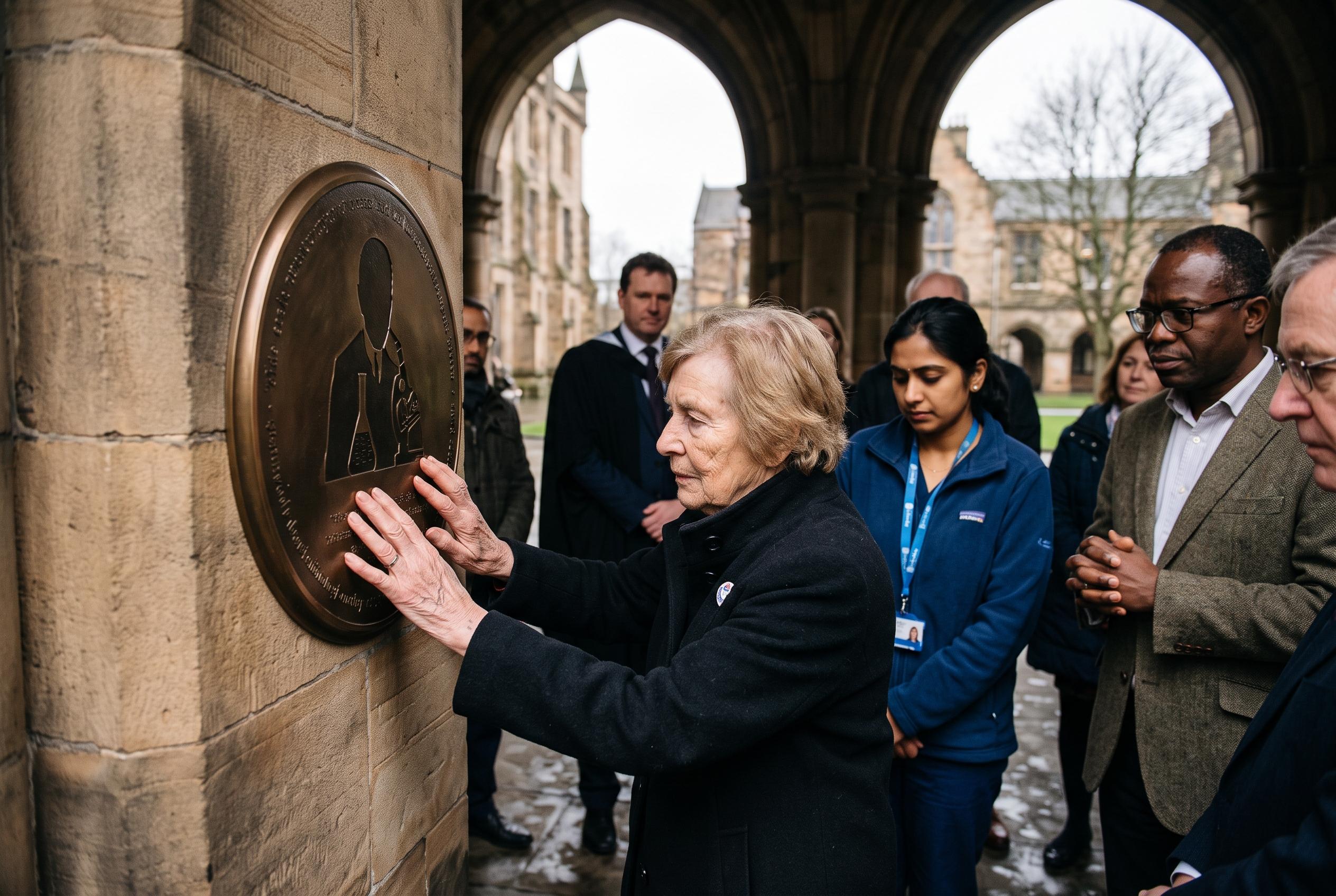
Recent memorials in Aberdeen have tried to turn that biography into something more visible. Diabetes UK said 300 guests attended the unveiling of the life-size bronze sculpture, described as the first monument in the world to honour Macleod and Scotland’s first storytelling statue of its kind. Visitors can scan a QR code to hear a short recorded monologue voiced by the Aberdeen-born actor David Rintoul. John Otto, founder of the memorial society, called seeing the project completed “surreal but gratifying”, while Diabetes Scotland’s John Kinnear said Macleod’s involvement in developing the world’s first clinically useful insulin was finally being recognised in public. (diabetes.org.uk)
Canada has marked the anniversary with public symbolism of its own. In 2021, as the University of Toronto staged an Insulin100 scientific symposium, an online exhibition, a commemorative stamp and a Heritage Minute, the Royal Canadian Mint issued a two-dollar coin to mark the centenary of the discovery. The university said three million coins were struck in total, including two million coloured versions and one million uncoloured, and quoted deputy prime minister Chrystia Freeland describing insulin as a discovery that “has saved millions of lives”. For Macleod, whose place in that history was long bitterly contested, the 150th anniversary arrives amid a broader recognition that the insulin breakthrough was built by a team he helped equip, direct and defend. (utoronto.ca)
Disclaimer: This content is for informational purposes only and is not intended to be a substitute for professional medical judgment, advice, diagnosis, or treatment.