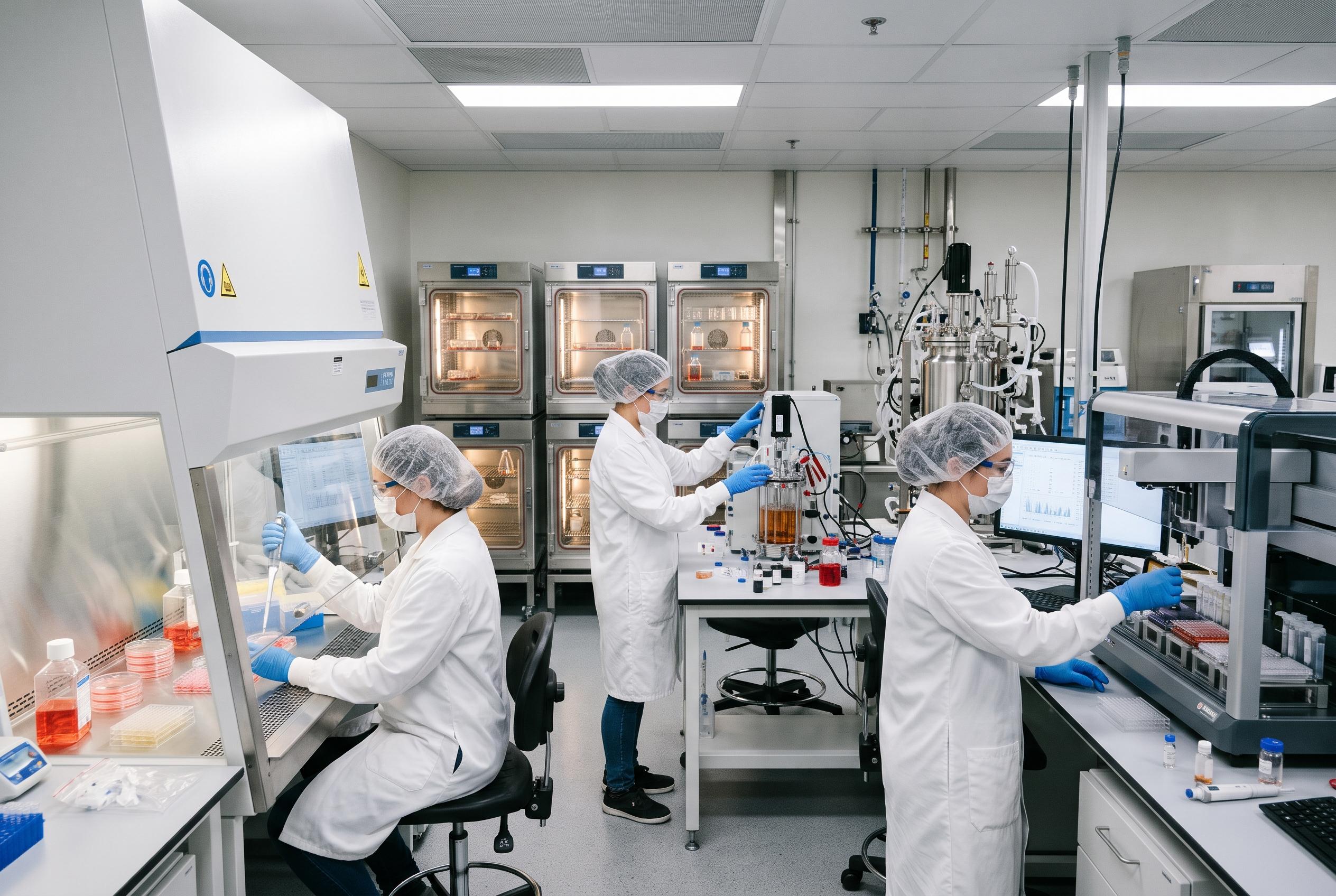

Healios is expanding Japanese production of its cell therapy ahead of global trials, while SAB Biotherapeutics advances a pivotal study of fully human antibodies for newly diagnosed type 1 diabetes.
At a Chardan discussion focused on how difficult biologic medicines can be made at scale, executives from Healios and SAB Biotherapeutics laid out plans that both hinge on manufacturing as much as on science. According to MarketBeat’s report, Healios chief financial officer Rich Kincaid described the company’s cell therapy for acute respiratory distress syndrome, while SAB chief executive Sam Reich explained how the company’s engineered cattle platform is being used to produce fully human polyclonal antibodies, including its lead programme in type 1 diabetes.
Kincaid said Healios’ multipotent adult progenitor cells, or MAPCs, differ from pluripotent stem cells because they are already committed to their end state and do not continue differentiating after administration. He said the cells are given intravenously to counter acute inflammation, and although they survive for only a few days, their effect is meant to continue by calming the immune response and supporting repair. In acute respiratory distress syndrome, the lungs can become overwhelmed by inflammation, forcing patients onto mechanical ventilation. Healios says its Phase II studies suggested patients were able to leave ventilators sooner and that mortality could fall. The company is now working towards conditional approval in Japan, where it has shifted manufacturing from Lonza in Singapore to Minaris in Yokohama and is using the process to generate data for a filing. Kincaid said Healios has also inherited production assets and technology from Athersys, and is running a 50-litre bioreactor operation in Yokohama that could produce about 1,000 doses a year, with a larger 500-litre facility in Kobe backed by a Japanese government grant and designed for far greater output.
Healios is also preparing for a global Phase III trial in pneumonia-induced acute respiratory distress syndrome, with Kincaid saying the study is expected to involve around 80 sites across the United States, Europe and parts of Asia. That broader push matters because the company is trying to show that its manufacturing model can support both a domestic regulatory path and a larger international programme. The move to build capacity in Japan also reflects a wider trend in cell and gene therapy: the commercial challenge is often less about proving a biological effect than about proving that the treatment can be produced consistently, cheaply and at scale.
Reich, meanwhile, presented SAB Biotherapeutics’ DiversitAb platform as a way to produce targeted, fully human intravenous immunoglobulin using transchromosomic cattle. SAB says the animals are engineered not to make bovine immunoglobulin G but instead to generate human antibodies after vaccination with a selected antigen, with the antibodies then purified from plasma. Reich contrasted that with conventional plasma-derived products and animal-derived therapies, arguing that SAB’s approach aims to combine the precision of targeted antibody generation with the ability to redose a fully human product. He said the company’s type 1 diabetes candidate is a fully human anti-thymocyte globulin built on earlier work with Sanofi’s rabbit-derived Thymoglobulin, which he said had shown preservation of C-peptide and lower HbA1c in two randomised trials.
SAB is now enrolling patients in its SAFEGUARD trial, a Phase IIb study that Reich described as pivotal and designed with registrational endpoints. The trial includes 159 newly diagnosed type 1 diabetes patients aged 5 to 40, split between higher-dose, lower-dose and placebo groups. The main goal is to preserve C-peptide, a marker of the body’s own insulin production, while HbA1c is being used as a key secondary measure of glycaemic control. Reich said the company has an agreement with the US Food and Drug Administration that could allow the study’s data package to support approval. He also pointed to the FDA’s approval of Tzield on the basis of C-peptide as an important precedent. In addition, SAB has begun the PRISE study with Dr. Haller and support from Breakthrough T1D, extending evaluation beyond the 100-day post-diagnosis window used in SAFEGUARD. Reich said the longer-running study could ultimately widen eligibility to patients up to two years after diagnosis if the data are positive. The company’s broader platform has been presented before in the context of infectious disease work, including programmes for influenza, COVID-19 and MERS-CoV, as well as a US Department of Defense contract for rapid-response antibody development.
Disclaimer: This content is for informational purposes only and is not intended to be a substitute for professional medical judgment, advice, diagnosis, or treatment.