

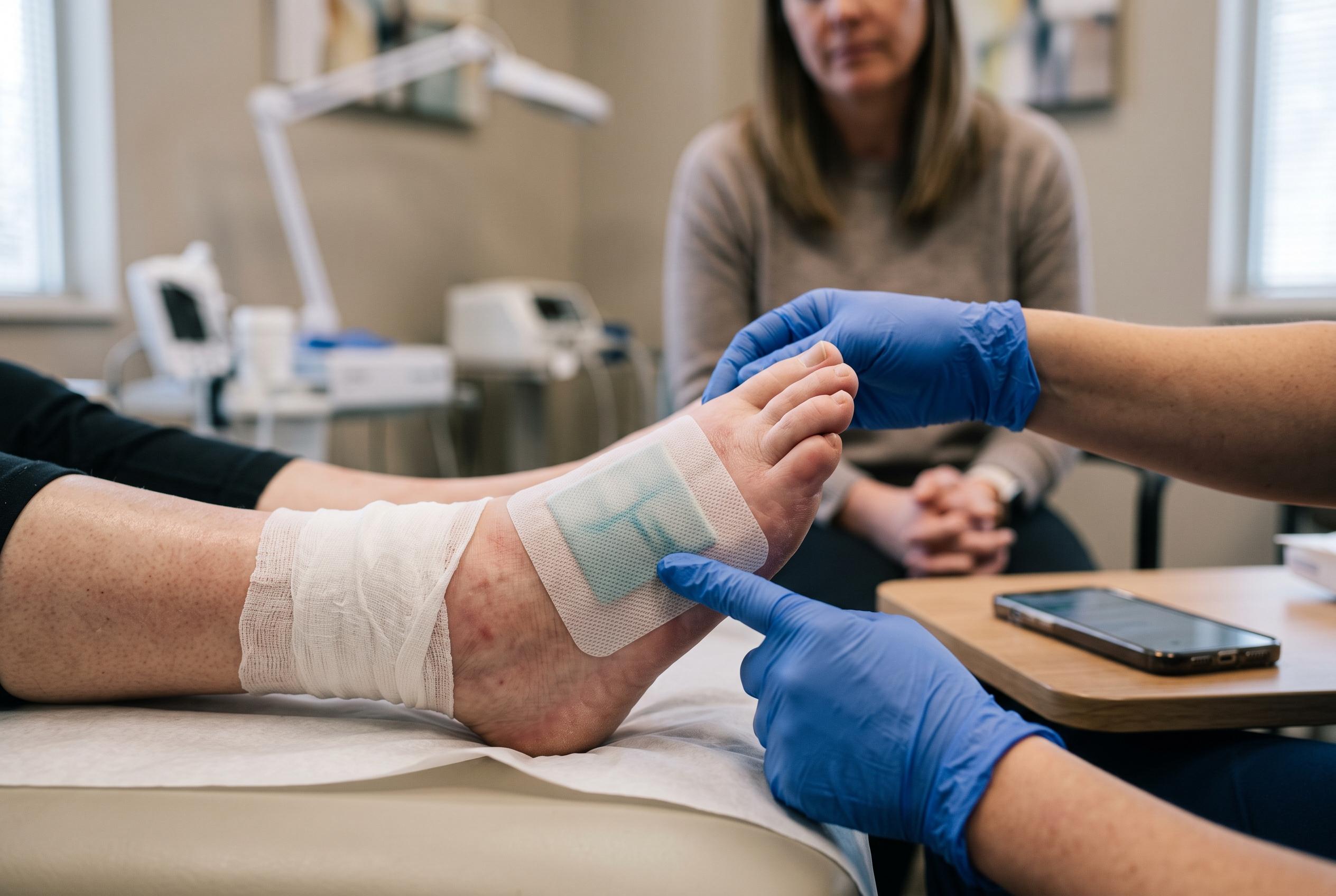

Researchers at KAIST have created a battery-free, wireless smart patch that visually and quantitatively monitors diabetic foot ulcers, potentially transforming wound management with real-time, non-invasive data via a colour-changing dressing and smartphone interface.
Researchers at the Korea Advanced Institute of Science and Technology have developed a wireless, battery-free smart patch that could change how diabetic foot ulcers are watched and managed. In work reported in Advanced Functional Materials and highlighted by LER Magazine, the device combines a colour-changing dressing with an optoelectronic sensor, allowing wound conditions to be tracked in real time without needles, cables or external power. The team says the patch can measure glucose, acidity and temperature at the wound site, while also letting patients view the results on a smartphone placed nearby.
The underlying dressing is made from electrospun nanofibres, a manufacturing method that uses an electric field to create fibres far thinner than a human hair. According to the KAIST researchers, the material responds to worsening wound conditions by shifting colour as glucose levels rise and acidity changes, giving patients and clinicians an immediate visual warning. That matters because diabetic foot ulcers can deteriorate quietly, and early detection of trouble can help prevent tissue damage and more serious complications.
The electronics built into the patch are intended to make those readings more reliable than ordinary camera-based monitoring. A light-emitting diode and a photodiode measure changes in the dressing’s reflected light and convert them into an electrical signal, reducing the influence of room lighting and other environmental variables. The research team says the result is a system that pairs a simple visual cue with quantitative data, offering both convenience and greater diagnostic consistency.
The wider research field suggests this approach is part of a broader move towards smarter wound care. A 2020 review in the Journal of Pharmaceutical Sciences and a 2019 study in the Asian Journal of Pharmaceutical Sciences both described electrospun nanofibres as promising wound dressings because they can mimic the body’s extracellular matrix, support cell growth and deliver bioactive compounds. More recent work has pushed the concept further, with an August 2023 review in Carbohydrate Polymers and a September 2026 review in ACS Biomaterials Science & Engineering both pointing to intelligent composite dressings as an emerging direction, while also noting manufacturing and long-term safety challenges. The KAIST patch fits into that progression by adding wireless sensing to a dressing that can already signal changing wound chemistry.
Disclaimer: This content is for informational purposes only and is not intended to be a substitute for professional medical judgment, advice, diagnosis, or treatment.



