

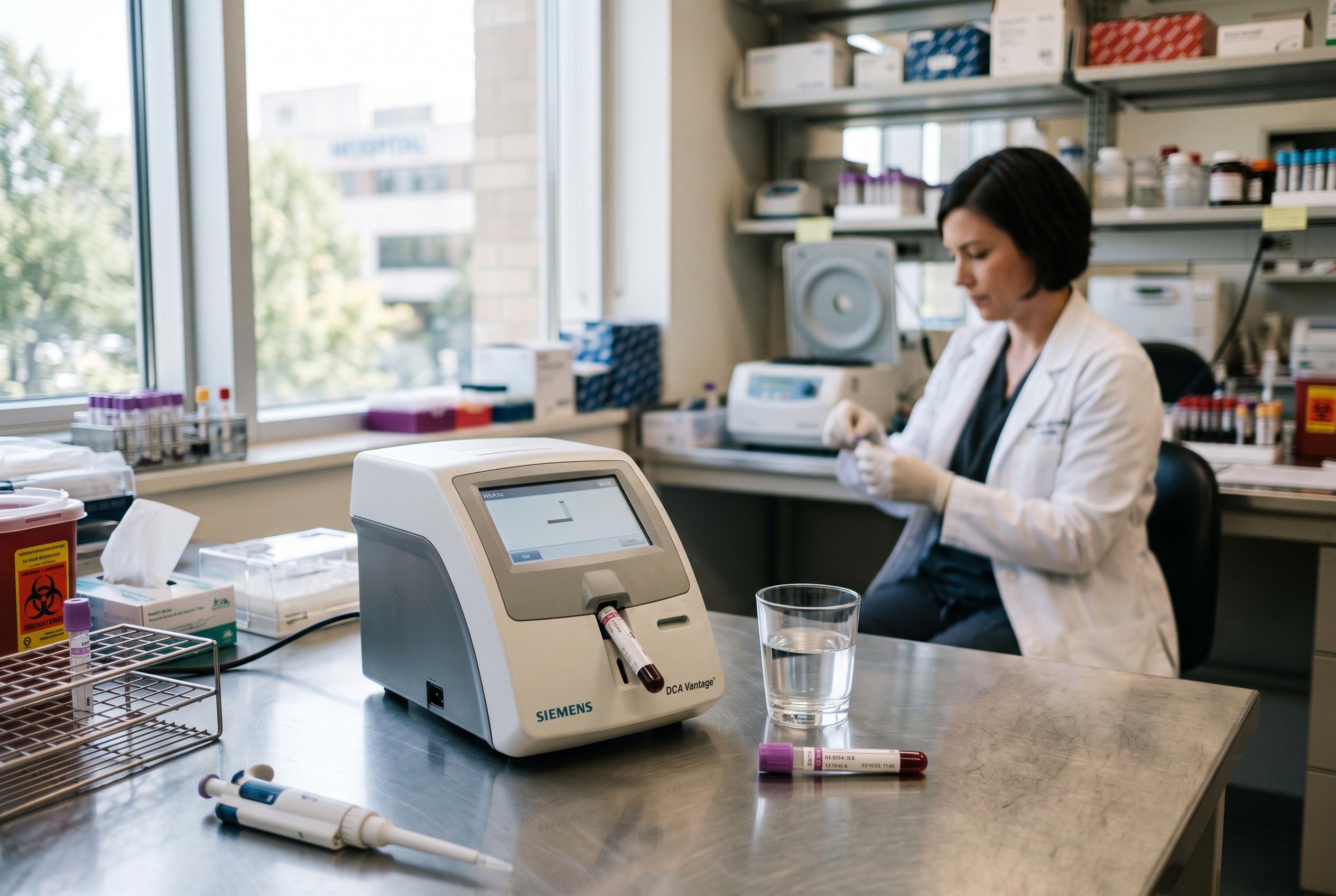

Despite differing estimates, analysts agree that the expanding demand for HbA1c testing, driven by rising diabetes prevalence and technological advances, will sustain double-digit growth in the market, with laboratories maintaining their dominance even as decentralised testing gains momentum.
Forecasts for the HbA1c testing device business are pointing in the same direction but from strikingly different starting points. Grand View Research estimates the market was worth $2.4 billion in 2025 and expects it to reach $4.2 billion by 2033, while Fortune Business Insights puts the 2025 figure much lower, at $1.65 billion, and projects $3.25 billion by 2034. Even with that gap, both firms are describing a sector growing at roughly 7% to 8% a year as diabetes screening expands and healthcare systems push testing closer to patients. (grandviewresearch.com)
That growth case rests on the clinical role of HbA1c, which remains a standard tool for diagnosing diabetes risk and tracking longer-term glucose control. Fortune Business Insights notes, however, that the test is not a universal answer: it has recognised diagnostic limits in gestational diabetes, in children, and in patients with anaemia or other blood disorders. Those caveats matter because they underline why accuracy, method choice and clinical setting still shape purchasing decisions, even as manufacturers market faster and more convenient systems. (fortunebusinessinsights.com)
The biggest revenues are still coming from conventional healthcare settings rather than the most heavily promoted decentralised ones. Grand View Research says laboratory-based systems accounted for 54.4% of market revenue in 2025, ion-exchange chromatography led technologies with 33.6%, and hospitals and clinics represented 57.1% of end use. North America held 33.8% of global revenue, although Asia Pacific is expected to be the fastest-growing regional market over 2026 to 2033. In other words, near-patient and home testing may be the strategic growth story, but central laboratories remain the commercial core for now. (grandviewresearch.com)
Performance data help explain why point-of-care competition has become so intense. On an Abbott page summarising an independent comparison of 19 point-of-care HbA1c devices, Afinion 2, Atellica DCA and OnCall MultiPro were the only three systems to achieve coefficients of variation of 2.0% or below in NGSP units at all three tested HbA1c concentrations. Only Afinion 2 and Atellica DCA met the equivalent IFCC precision threshold at all levels, and Abbott says Afinion 2 was the sole point-of-care device to clear the stricter IFCC sigma benchmark associated with clinical-trial suitability. That matters because poor precision or bias can translate into missed diagnoses or the wrong treatment decisions. Abbott’s push into this segment is not new: Fortune Business Insights notes that the company launched the Afinion HbA1c assay in June 2019 as a rapid point-of-care test to aid diagnosis. (globalpointofcare.abbott)
Among more recent competitive moves, Trinity Biotech’s Brazil launch stands out because it combines regulatory progress with a performance claim the company says no rival currently matches. In a 12 March 2026 announcement carried by Nasdaq, Trinity said it had begun commercial rollout in Brazil of the next-generation HbA1c column system for its Premier Hb9210 platform after local approval. The company said the enhanced analyser had recently become the only HbA1c system worldwide to receive IFCC Gold classification for 2026. John Gillard, Trinity’s president and chief executive, said: “Brazil is one of the world’s most important diabetes markets, and regulatory approval of our upgraded Premier Hb9210 HbA1c system marks a significant step forward for our haemoglobin business and positions it well for long-term profitable growth.” Grand View Research separately describes the Brazilian product as a boronate-affinity column platform, a technology category it expects to grow quickly because it is less vulnerable to interference from haemoglobin variants. (nasdaq.com)
Regulators are also widening the field for newer entrants. FDA records show Shanghai Medconn Medical Technology’s Medconn Glycated Hemoglobin Test system, under 510(k) number K242911, was found substantially equivalent on 20 June 2025. The clearance covers the MQ3000 and MQ3000PT analysers, classed under 21 CFR 862.1373 as haemoglobin A1c test systems within clinical chemistry. The FDA summary says the system uses ion-exchange high-performance liquid chromatography and is intended not only for monitoring long-term glucose control in people with diabetes, but also as an aid in diagnosis and in identifying patients at risk of developing diabetes. The predicate device listed was Bio-Rad’s D-100 HbA1c system. (accessdata.fda.gov)
In the United States, reimbursement is moving at the same time as regulation. CMS said it issued the 2026 Medicare Physician Fee Schedule final rule on 31 October 2025, effective on or after 1 January 2026. The agency said the final non-qualifying APM conversion factor for 2026 was $33.40, up 3.26% from $32.35, while the qualifying APM conversion factor rose to $33.57, a 3.77% increase. Those are not HbA1c-specific payment lines, but they help set the economics for physician services that rely on diagnostic testing and may influence how readily clinics absorb new equipment or expand testing volumes. At the same time, Grand View Research notes that acquisition costs, consumables and servicing remain a brake on adoption, especially for smaller providers. (cms.gov)
What emerges is a market with solid demand but less certainty than headline growth claims suggest. Analysts disagree materially on current size, yet they broadly agree that diabetes prevalence, undiagnosed disease and pressure for faster decision-making will keep demand rising. The likely winners are not simply the firms selling the cheapest machine or the most portable one, but those able to show laboratory-grade performance, navigate formal clearances and fit into hospital, clinic and near-patient workflows without compromising reliability. That is why laboratory platforms still dominate revenue even as manufacturers and investors keep chasing the next phase of point-of-care expansion. (grandviewresearch.com)
Disclaimer: This content is for informational purposes only and is not intended to be a substitute for professional medical judgment, advice, diagnosis, or treatment.