

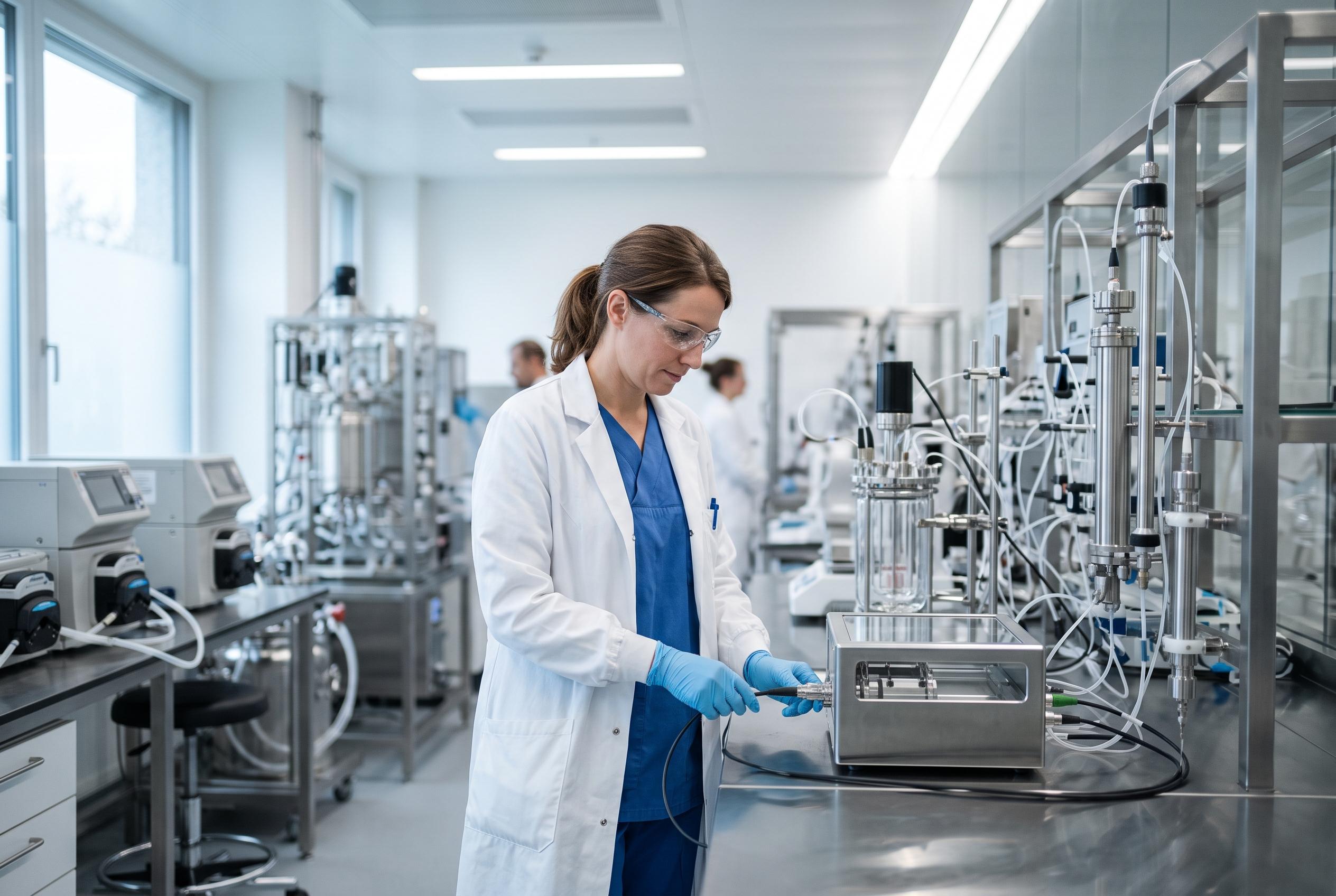

A dual-stream transformer combining Raman and near-infrared spectra delivered more accurate, low-latency glucose estimates, strengthening the case for closed-loop control in advanced biomanufacturing.
A new multimodal sensing approach could make glucose monitoring far more reliable in bioprocessing, a long-running challenge in fed-batch fermentation and an increasingly important one as manufacturers move towards hybrid and continuous production for advanced therapies. In a paper published in Bioprocess and Biosystems Engineering, researchers led by Xiwei Tian of East China University of Science and Technology and Yinlan Ruan of Guilin University of Electronic Technology describe a soft-sensing framework that combines Raman and near-infrared spectroscopy to deliver faster, more accurate glucose estimates than existing methods.
The appeal of the approach lies in the strengths of the two optical techniques. Raman spectroscopy is valued for its highly specific molecular fingerprints, while near-infrared spectroscopy offers broader spectral coverage. By processing each stream separately before merging them through a dual-stream, cross-attention transformer architecture, the team created a model designed for online use, with low latency and high measurement frequency. In tests on 142 synchronised, preprocessed Raman-NIR records, the model accounted for 99% of the variation in true glucose concentration, with a root mean square error of 1.09 grams per litre and a mean absolute error of 0.89 grams per litre.
Those results matter because glucose is a critical control variable in mammalian and microbial fermentation. The authors said their method held up across five-fold validation and outperformed partial least squares regression, gradient boosting regression trees, convolutional neural networks and temporal convolutional networks under the same evaluation conditions. They also reported that perturbation analysis showed the model depended heavily on Raman data, with the strongest sensitivity in the 1122-1335 cm-1 interval, a region associated with carbohydrate vibrational modes. That level of stability is particularly valuable in process control, where even occasional outliers can distort feeding decisions.
The study fits into a broader shift in biopharmaceutical manufacturing, where process analytical technology has become central to quality by design and tighter control of upstream operations. Earlier reviews have described Raman spectroscopy as a first-choice monitoring tool for glucose, lactate and other process variables, while more recent industry activity shows continued investment in optical sensing for bioprocesses, including at-line, in-line and in situ deployment. If the new hybrid framework proves robust outside the laboratory, it could strengthen the case for closed-loop glucose control and support the gradual move away from traditional fed-batch processing towards more continuous manufacturing.
Disclaimer: This content is for informational purposes only and is not intended to be a substitute for professional medical judgment, advice, diagnosis, or treatment.



