

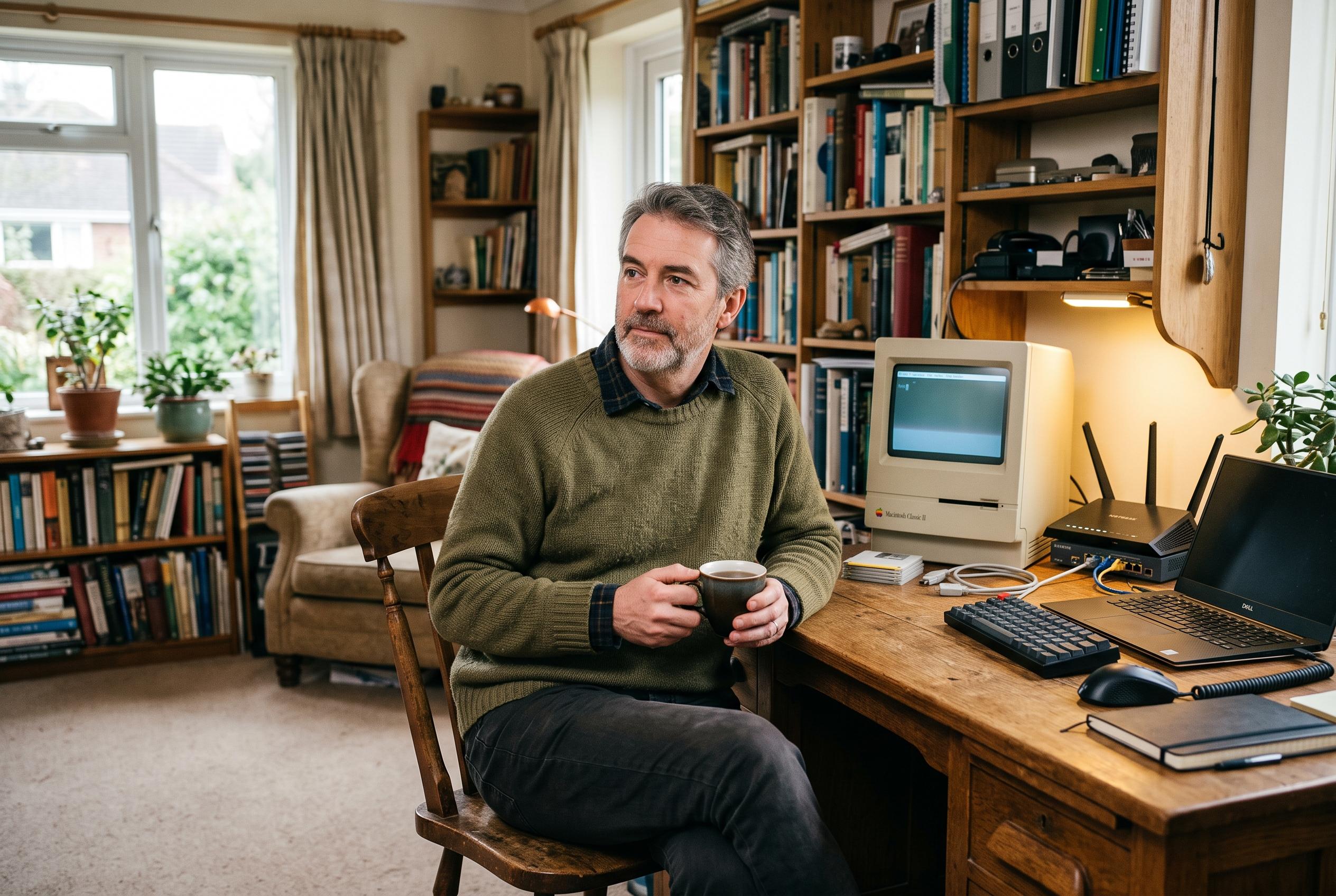

A reflective newsletter spans retro internet archaeology, Apple’s subscription push, home-network upgrades and the practical habits behind lasting health improvements.
In his February 9, 2026, newsletter, Chuq Von Rospach describes a month that feels both seasonal and personal: the days are lengthening, the winter weather has been harsh but manageable, and the raccoons that once treated his bird feeder like a breakfast buffet have finally been pushed back by pepper-treated seed. He says the experiment has mostly worked, though a few determined squirrels remain unimpressed. The tone of the piece is reflective and practical, with Von Rospach moving easily from backyard problem-solving to longer-running projects and the slow satisfaction of seeing progress accumulate over time. The broader appeal of that approach is familiar to readers who have followed the recent resurgence of retro internet archives and personal web publishing, including projects such as OldUse.net and the larger Usenet-Rewind archive.
One of the more striking passages concerns a curious piece of internet archaeology: someone got in touch to ask whether Von Rospach was the same person who once posted on Usenet. He says that question led him to a project that replays old Usenet messages as though they are being posted now, decades after the fact. Boing Boing has reported on similar efforts, including Usenet-Rewind, which preserves an enormous archive of messages stretching back to 1981, while OldUse.net has long advertised itself as a way to recreate the feel of early network conversation. For Von Rospach, the experience is amusing and faintly disorienting, a reminder that the early web is now history enough to be curated and staged for a new audience.
He also turns to Apple’s recently announced creator subscription bundle, which he says has enough appeal to tempt him into signing up for a year. Reporting from 9to5Mac says Apple introduced Apple Creator Studio in January 2026, bundling apps such as Final Cut Pro, Logic Pro and Pixelmator Pro under a subscription model, with newer AI-related features helping justify the change. Von Rospach’s interest is practical rather than ideological: he wants to test Pixelmator as a possible Photoshop replacement, and he is curious about whether the bundle’s broader app mix offers enough value to make the switch worthwhile. He is less enthusiastic about the subscription trend itself, but accepts that software businesses increasingly rely on recurring revenue to fund new features and support ongoing development.
He notes, too, that the launch appears to have been a little rough around the edges. Later coverage by 9to5Mac said Apple removed older standalone versions of Pages, Keynote and Numbers from the Mac App Store in April, signalling a tighter link between the company’s newer software builds and the subscription package. The same outlet reported that some features, including the Liquid Glass design treatment in Pixelmator Pro, were being held back for Creator Studio subscribers, a reminder that Apple is now using the bundle not just as a convenience offer but as a way to segment access to new capabilities. Von Rospach’s response is measured: he sees the subscription as imperfect, but still potentially useful if the underlying tools continue to improve.
Another small but telling shift comes in his account of design staffing at Apple. He says he was surprised by the appointment of Sebastiaan de With to Apple’s design team, and reads it as a meaningful sign of movement within a department that has drawn criticism in the past. 9to5Mac reported in January that de With, best known as the co-founder behind the Halide camera app, had joined Apple, a move that immediately raised questions about what it could mean for the future of Halide and for Apple’s own design direction. Von Rospach treats the hiring as a positive signal, suggesting it may point to a fresh phase for Apple’s software design culture after a period he regards as uneven.
He is equally decisive about another experiment: the two-watch routine he adopted after buying Apple Watch Series 11. For a while, he wore the newer watch during the day and kept the older Series 10 for sleep tracking, but he has now abandoned that arrangement and returned to one watch. The change is not about dissatisfaction with the device, he says, but about convenience. Managing software updates on two watches became tedious, and a planned trip made him question whether carrying the spare was worth the trouble. The experiment worked, but only to the point where simplicity won out over redundancy.
The longest section of the newsletter is devoted to a home-network overhaul. Von Rospach explains that his house had been running on a patchwork of Eero units, with recurring throughput problems and the occasional need for full reboots. He replaced that setup with three Eero 7 Pro units and says the difference was immediate: stronger signal, better coverage to the garage and outdoor cameras, and much faster transfers between floors. The upgrade also required one moment of patience when the old gateway held on to the upstream connection, but after a full power reset the system settled down. His account matches Eero’s own long-running emphasis on simple setup and managed mesh networking, though the practical point for him is more straightforward: the new gear has, at last, made the house network feel reliable.
The final major thread in the newsletter is personal health. Von Rospach says people have asked whether his weight loss came from a new diet or from GLP-1 medication, and he answers that the real change was behavioural rather than pharmaceutical. He says he has been on Victoza for years, but that the biggest difference came from tracking what he ate, cutting portions, and lowering his daily calorie intake by making smaller, more sustainable adjustments. He frames the effort as a long-term lifestyle shift rather than a temporary programme, and says the results have been significant: less weight, lower insulin use, better mobility and a renewed sense of control. That emphasis on gradual, durable change gives the piece its emotional centre, tying together the practical fixes, technical tinkering and small victories that run through the rest of the newsletter.
Disclaimer: This content is for informational purposes only and is not intended to be a substitute for professional medical judgment, advice, diagnosis, or treatment.



