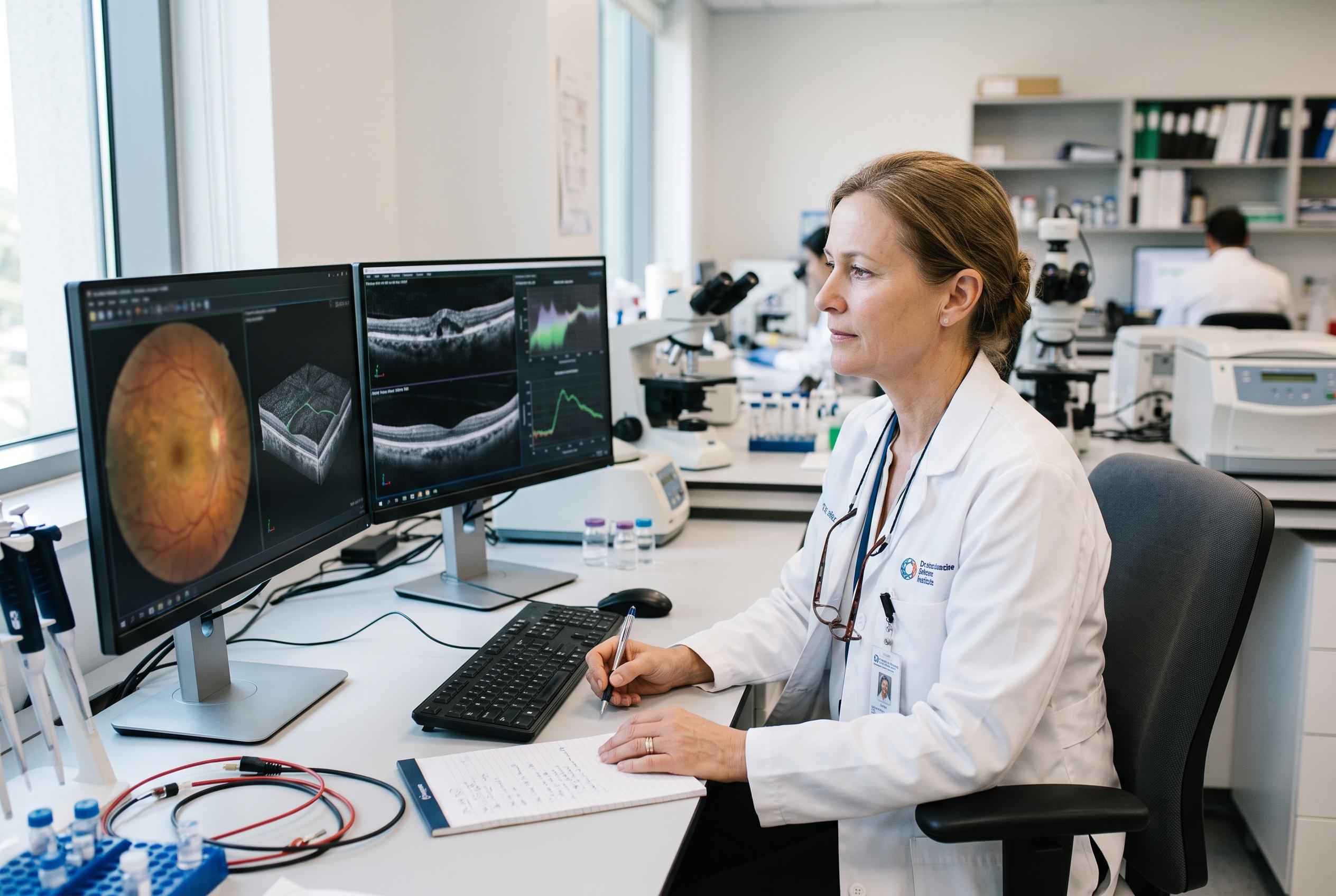

Researchers in Turin and Voiant say a pre-treatment imaging model could help predict individual responses to anti-VEGF therapy, although further clinical validation is needed.
A collaboration involving Voiant and researchers in Turin has reported that machine-learning tools may help predict how patients with diabetic macular oedema respond to treatment. According to the company and the study authors, the work was published in the journal Eye and focused on using pre-treatment imaging to estimate both functional and structural outcomes after anti-VEGF therapy, a common treatment for the eye condition.
The research was led by Lorena Ulla, working with Enrico Borrelli’s group at the University of Turin and the City of Health and Science Hospital in Turin, alongside Voiant executives Jonathan Oakley and Daniel Russakoff. The company said the model could do more than classify likely responders and non-responders: it also aimed to predict the size of change in best-corrected visual acuity, which measures how well a person sees with the sharpest correction possible, and central subfield thickness, a retinal measurement used to track swelling.
In the company’s account of the findings, the model achieved an R-squared score of 0.66 for visual change and 0.63 for retinal thickness change. Those figures suggest a moderate level of explanatory power, although they do not by themselves prove that the system would be reliable in everyday clinics without further validation. Similar work published elsewhere has also pointed to the potential of machine learning and optical coherence tomography, a scan used to image the retina, to identify patients with diabetic macular oedema who are likely to respond poorly or have persistent swelling despite treatment.
Borrelli said the research was aimed at showing how artificial intelligence could support clinical decision-making by adding more information before treatment begins. Oakley said the collaboration underlined Voiant’s wider effort to refine pre-screening and prognostic imaging methods, not only for diabetic macular oedema but across other indications. The broader medical context is significant: diabetic macular oedema is a complication of diabetic retinopathy and a major cause of vision loss in people with diabetes, with high blood sugar damaging retinal blood vessels and allowing fluid to leak into the macula.
Disclaimer: This content is for informational purposes only and is not intended to be a substitute for professional medical judgment, advice, diagnosis, or treatment.