

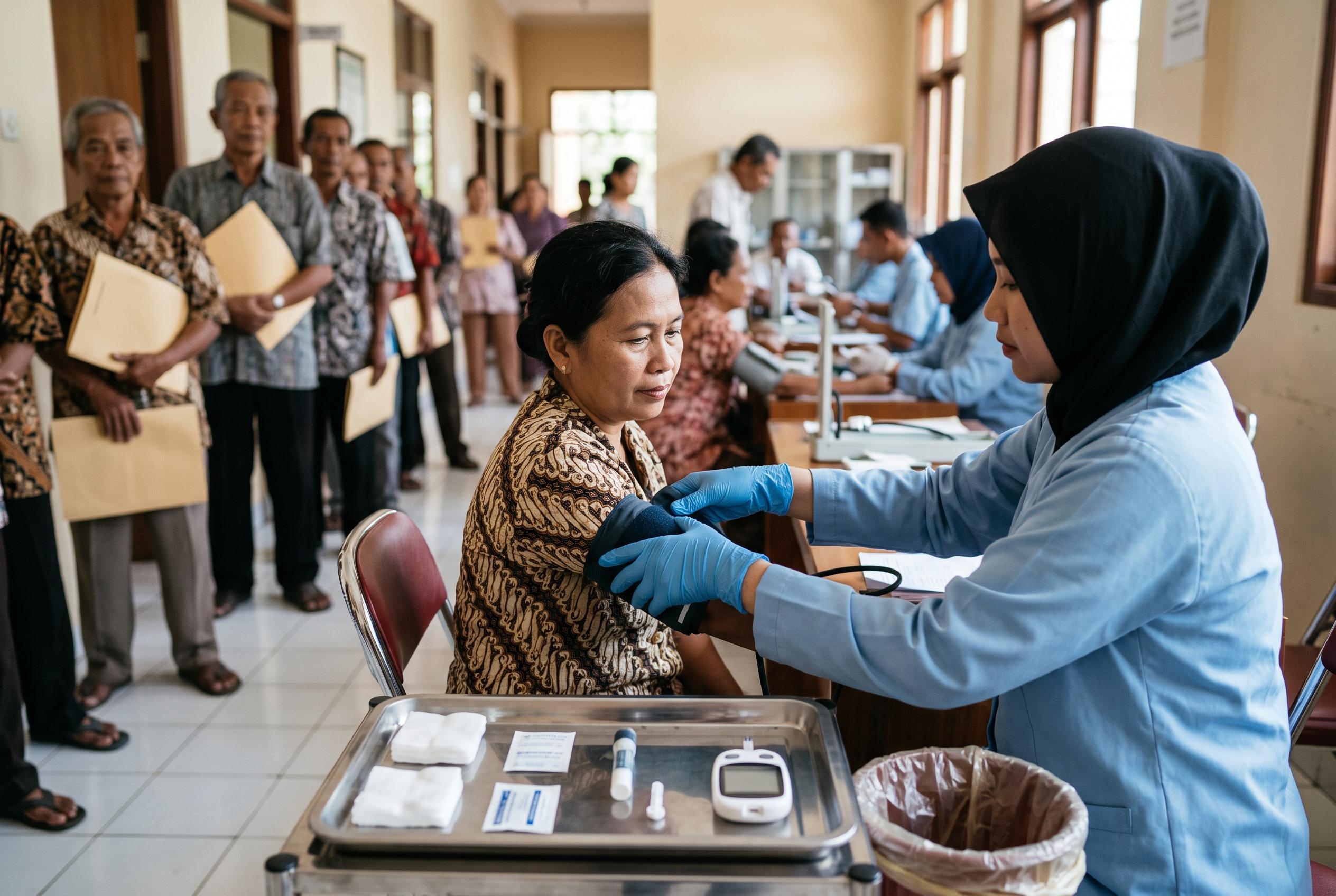

Indonesia’s Ministry of Health reports significant progress in its free health screening initiative, now reaching nearly 100 million people and targeting 130 million to combat non-communicable diseases and tuberculosis nationwide.
Indonesia’s Ministry of Health says its free health check programme has now reached 99.1 million people, marking rapid progress towards a 130 million-person target as the government tries to widen early detection of disease across the country.
Deputy health minister Dante Saksono Harbuwono said at a press conference in Jakarta on Wednesday that the Free Health Check, known as CKG, has become the ministry’s largest public-facing health intervention. The ministry said 78.5 million people have taken part in annual screenings at community health centres and within local communities, while another 20.6 million were screened at schools.
The government is now pairing broader access with follow-up treatment. According to the ministry, the 2026 strategy focuses on what happens after screening, including free treatment through the national health insurance system, education on healthier lifestyles and classifying patients by condition, from normal to pre-disease and disease. The ministry has said this is intended to prevent screening from becoming a one-off exercise.
Non-communicable diseases remain the main concern. The ministry said hypertension, diabetes and high cholesterol are among the most common problems detected across age groups, and it argued that the programme could help prevent one in four stroke and cardiovascular cases by 2035 if early detection and risk-factor control continue. The ministry also said follow-up data suggests some benefit: among hypertension patients who returned for screening in 2026 after taking part in 2025, 46.9% had controlled blood pressure, while 69.4% of returning diabetes patients had controlled blood sugar.
Alongside the screening drive, the ministry is intensifying efforts against tuberculosis, which remains another national priority. Dante said TB case-finding had reached 55% of the estimated national burden in 2026, with the monthly target rising steadily towards 90% by December. The ministry has been integrating TB screening into CKG visits at health centres, schools, Islamic boarding schools and community sites, and said more than 20.6 million people were screened for TB in 2025, leading to 26,802 new positive cases. It also said active case-finding using X-rays and artificial intelligence across prisons, boarding schools and communities in 38 provinces identified 14,546 new TB cases.
The ministry has also expanded one-stop diagnostic services that combine X-ray, molecular testing and other checks, with 105 community health centres offering the service this year and a longer-term plan to extend it to 5,000 centres in 11 priority provinces. In another strand of reform, the government is upgrading 66 district hospitals from class D or D Pratama to class C in stages between 2025 and 2027, as part of a broader effort to improve access to care outside the major cities.
Disclaimer: This content is for informational purposes only and is not intended to be a substitute for professional medical judgment, advice, diagnosis, or treatment.



