

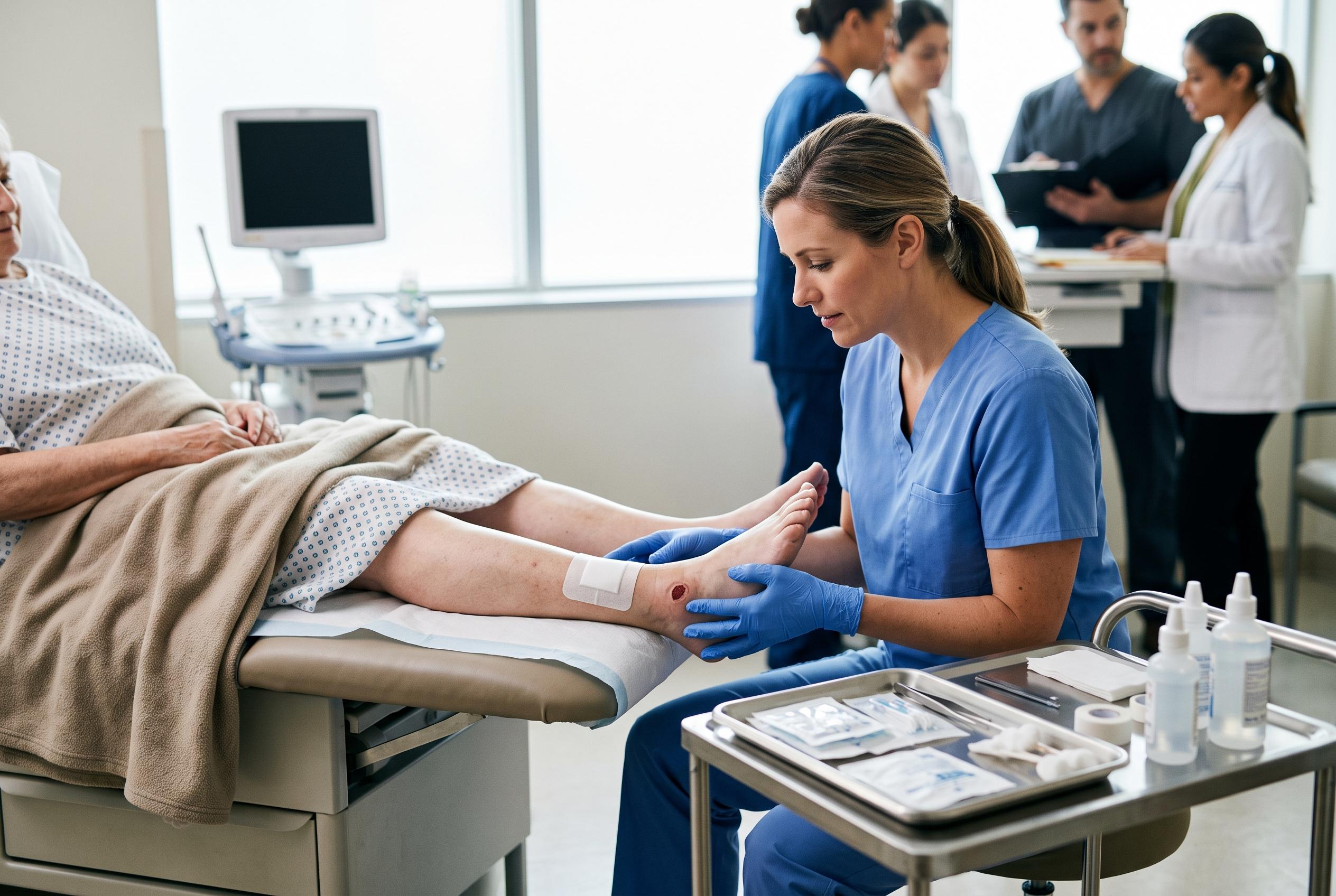

The Japanese Dermatological Association has released revised evidence-based guidelines for diagnosing and treating diabetic skin ulcers and gangrene, emphasising systemic factors, advanced therapies, and multidisciplinary care to improve patient outcomes.
The Japanese Dermatological Association has issued a revised set of guidelines for the diagnosis and treatment of diabetic skin ulcer and gangrene, bringing together evidence on assessment, infection control, blood-flow testing, wound care and selected advanced therapies. The document says the aim is to improve the quality of care in Japan by presenting evidence-based recommendations that reflect both skin disease and the broader complications of diabetes.
The guideline, prepared by the association’s Wound/Pressure Ulcer/Burn Guidelines Drafting Committee, was revised through a process that began in 2018 and continued through online and mail-based meetings during the pandemic. It was also shaped by member comments collected on the association’s website in 2023 before publication. According to the association, the Japanese edition will appear in the Japanese Journal of Dermatology and will be freely available to download, while an English version is due the following year.
The document places diabetic foot disease in a wider clinical context, noting that it is commonly driven by peripheral neuropathy, peripheral arterial disease or both, and can be made worse by infection. It says the condition should be understood not simply as a skin problem but as part of a systemic disorder in which blood sugar control, nutrition, circulation and nerve damage all influence healing. The guideline also contrasts Japan’s treatment environment with that of countries where podiatry and other specialist roles are more deeply embedded, arguing that overseas guidance cannot be applied wholesale without adjustment.
For diagnosis, the association recommends combining clinical examination with tests that reflect neuropathy and circulation. It highlights the Semmes-Weinstein monofilament test, tuning fork assessment and Achilles tendon reflex testing for peripheral neuropathy, and says circulation should be assessed with measures such as ankle brachial pressure index, toe brachial index, skin perfusion pressure and transcutaneous oxygen pressure. Where infection is suspected, the guideline advises drawing on symptoms, blood tests, imaging and bacterial cultures rather than relying on any single marker.
Severity and prognosis are to be judged with established classification systems, including the Wagner scale, the University of Texas system and WIfI, which helps estimate wound risk and guide treatment. The guideline also gives practical definitions for terms such as diabetic skin ulcer, gangrene, peripheral arterial disease and critical limb ischaemia, underlining the importance of standard terminology in a field where care is often multidisciplinary.
A major theme of the document is that diabetic wounds heal poorly because of several overlapping barriers, including local hypoxia, hyperglycaemia, reduced mobility, infection and impaired circulation. The guideline therefore recommends addressing the underlying diabetes, providing nutritional support and managing co-existing vascular disease alongside local wound care. It says debridement may be necessary, but warns that in patients with peripheral arterial disease, especially those with osteomyelitis, surgical removal of dead tissue must be approached cautiously.
On treatment, the panel gives weak recommendations in favour of negative-pressure wound therapy and platelet-rich plasma therapy, while acknowledging that the overall evidence base is limited and largely drawn from studies outside Japan. For negative-pressure wound therapy, the guideline says available studies suggest faster reduction in wound size and, in some trials, shorter healing times, though results were inconsistent and blinding was difficult. For platelet-rich plasma, the committee found signals of benefit in wound closure and no clear increase in adverse events, but said the data were too heterogeneous for strong conclusions.
The guideline also addresses adjunctive measures such as hyperbaric oxygen therapy, orthoses, topical preparations, dressing materials and systemic antimicrobials. It notes that weight-bearing orthoses can help offload pressure, while antibiotics should be reserved for appropriately diagnosed infection, with longer courses for severe cases. For osteomyelitis, MRI was described as a useful and widely available option in Japan, with the panel concluding that imaging should support, not replace, the clinical picture.
The association says the new guidance will be reviewed again in five years, unless an earlier update becomes necessary. It also plans to check how widely the recommendations are adopted and whether they change clinical practice through a questionnaire survey after publication.
Disclaimer: This content is for informational purposes only and is not intended to be a substitute for professional medical judgment, advice, diagnosis, or treatment.



