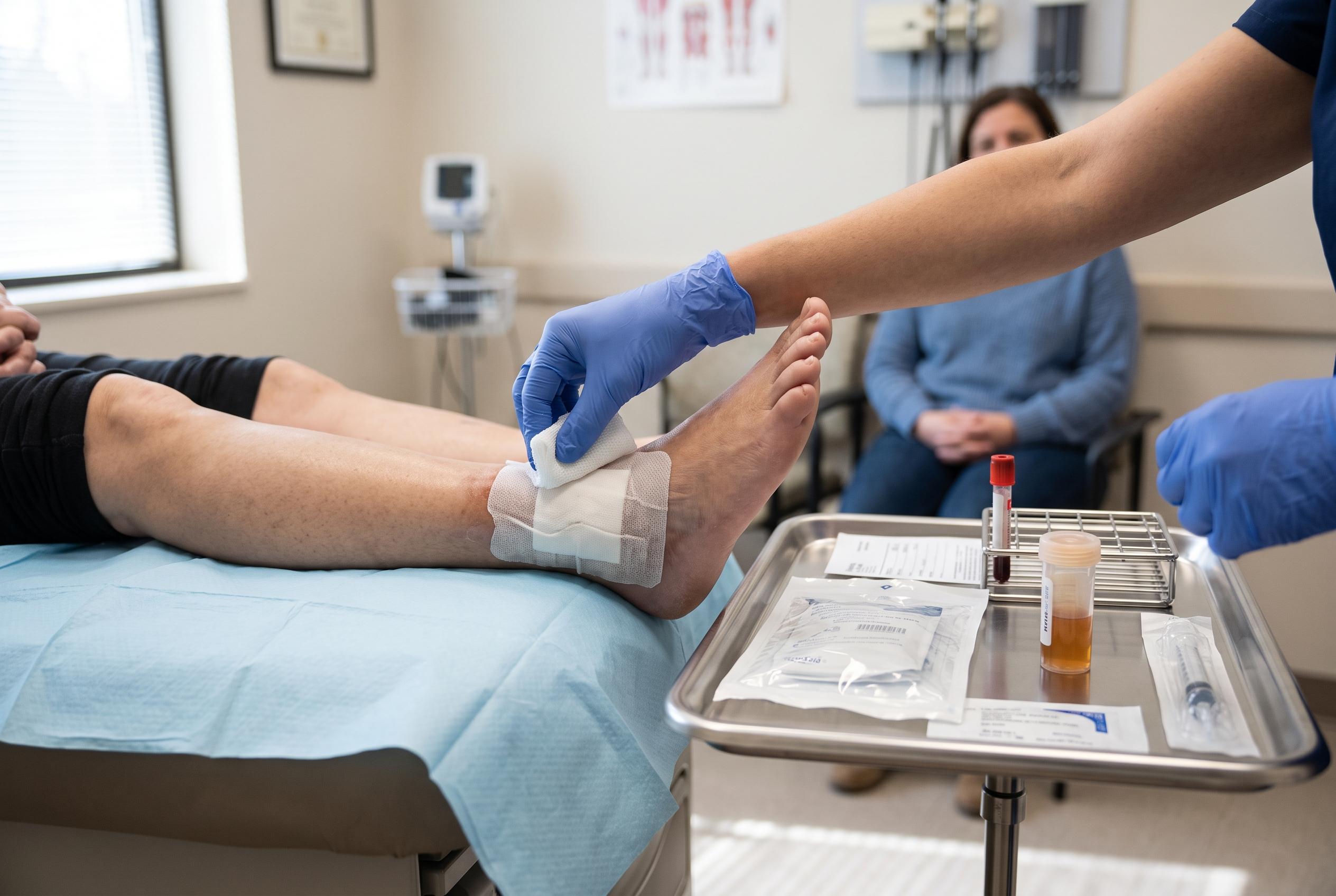

A new review highlights promising results for platelet-rich plasma as an adjunct therapy for diabetic foot ulcers, yet underscores the need for standardised research to confirm its long-term safety and efficacy.
Platelet-rich plasma is emerging as a possible add-on treatment for diabetic foot ulcers, one of the most stubborn and dangerous complications of diabetes. A new cross-sectional appraisal published in Dove Medical Press reviewed 11 overlapping meta-analyses and concluded that the strongest available evidence points to better healing outcomes when PRP is used alongside standard wound care, though the review also shows that the field remains marked by uneven methods and inconsistent reporting.
Diabetic foot ulcers are a major clinical problem because they heal slowly and can lead to infection, hospital admission, amputation and death. The appraisal notes that routine care still rests on blood sugar control, debridement, infection management, pressure off-loading, dressings and, when needed, vascular treatment. Yet those measures do not always succeed, particularly in long-lasting or complex ulcers, which has helped drive interest in regenerative approaches such as PRP.
PRP is prepared from a patient’s own blood and is rich in platelets that can release growth factors and other biologically active substances after activation. In theory, those factors may improve new blood vessel growth, support fibroblast activity, speed tissue repair and reduce inflammation. Several earlier meta-analyses have already suggested benefit. One PubMed-indexed review from 2019 reported higher rates of chronic wound healing, smaller ulcer volume and shorter healing time with PRP, while finding no clear increase in complications. More recent analyses have been even more favourable: a 2023 meta-analysis of 17 randomised controlled trials involving 1,303 patients found that autologous PRP significantly improved complete healing and shortened healing time, without raising adverse event rates. Another review from 2024 also reported better healing and shorter recovery times, again with no meaningful difference in safety outcomes.
The problem, according to the new appraisal, is not the absence of positive signals but the inconsistency of the evidence base. The authors compared studies published between 2018 and 2025 and found that the reviews used different search strategies, eligibility rules, outcome definitions and statistical methods. Some limited themselves to English-language papers, while others did not clearly state language restrictions. The number of randomised trials included in the reviews ranged from eight to 22, and heterogeneity was substantial in several analyses, meaning the results varied widely across studies. The appraisal also found variation in review quality, with AMSTAR scores ranging from six to 10 out of a possible 11.
To sort through those conflicting conclusions, the authors applied the Jadad decision algorithm, a framework designed to identify the most reliable meta-analysis when several reviews cover the same question. On that basis, they judged a 2023 review led by Su YN to be the most credible synthesis. That analysis found that autologous PRP increased the chance of complete ulcer healing and reduced the time needed for healing, while adverse events were not significantly different from standard care. The new appraisal says this makes PRP look like a promising adjunct rather than a universal solution, especially as the benefits were clearest for wound closure rather than for outcomes such as infection or amputation.
The authors caution that the evidence still falls short of delivering final answers on optimal PRP preparation, dosing, application methods or long-term safety. They argue that PRP may be reasonable for selected patients with refractory ulcers, but not as a blanket replacement for established care. What is needed now, they say, are larger, standardised randomised trials with longer follow-up and clearer reporting, so that clinicians can determine where PRP genuinely adds value and where it does not.
Disclaimer: This content is for informational purposes only and is not intended to be a substitute for professional medical judgment, advice, diagnosis, or treatment.