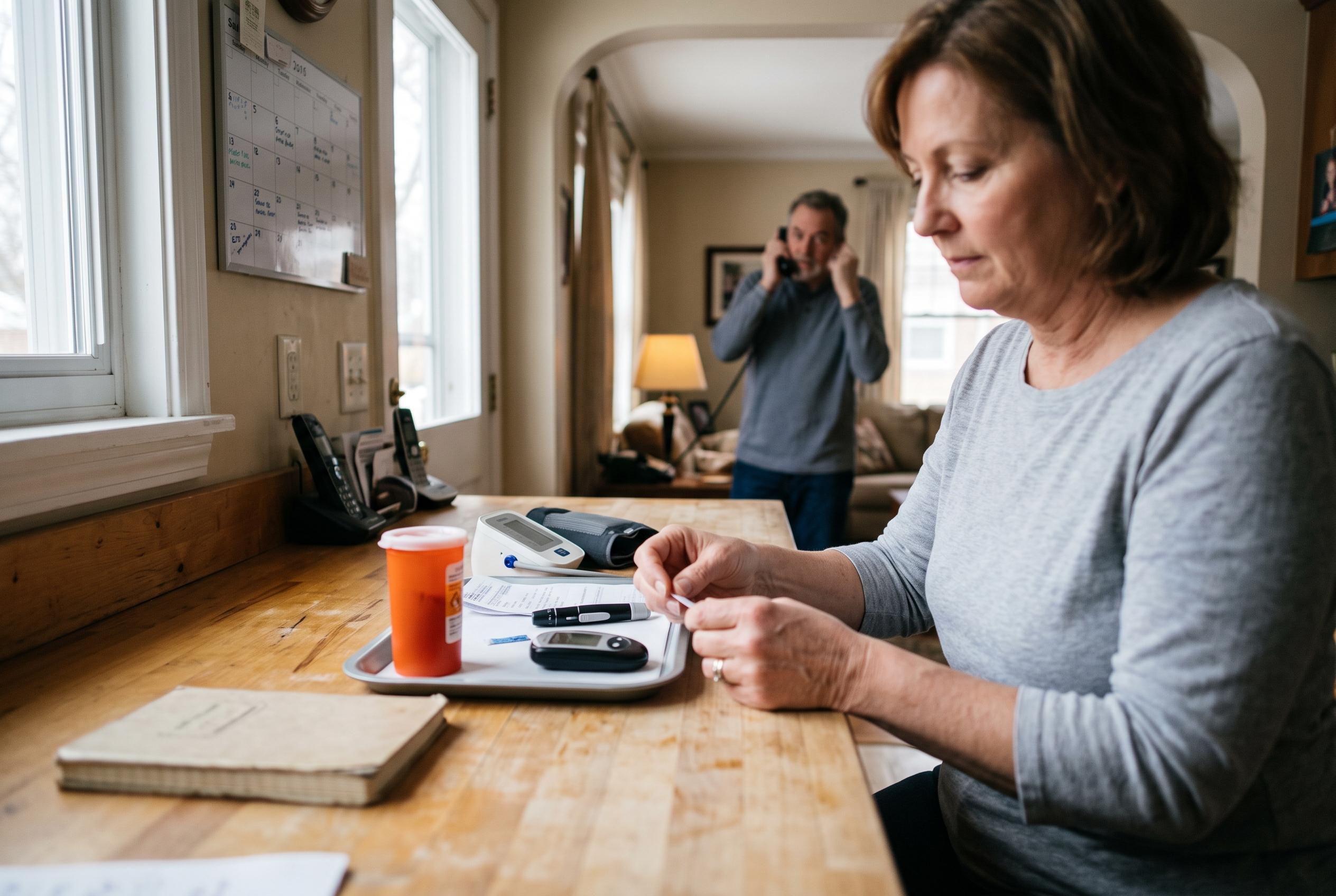

A new study suggests that sustained control of blood sugar and blood pressure over a year provides more accurate prediction of kidney complications in people with type 2 diabetes than single clinic measurements.
A year’s worth of blood sugar and blood pressure readings may say more about kidney risk in people with type 2 diabetes than a single good clinic visit. In an American Journal of Kidney Diseases paper published online on 17 July 2026, researchers using data from the ACCORD trial found that patients who spent more time with both HbA1c and systolic blood pressure inside their target ranges were less likely to go on to serious renal complications.
The analysis was not a new randomised trial but a post hoc cohort study drawn from ACCORD, the large US study of adults with type 2 diabetes at high cardiovascular risk. Xi Meng and colleagues at Ruijin Hospital, Shanghai Jiao Tong University School of Medicine examined 6,542 participants who had hypertension and at least three HbA1c and systolic blood pressure measurements during the first 12 months after randomisation. The official journal abstract describes four joint exposure groups built around an 80% cut-off, allowing the team to compare people who kept neither measure in range for most of the year, one but not the other, or both.
What stood out was the gradient in risk. Patients whose HbA1c stayed in range for the whole year had a 20% lower hazard of the composite kidney outcome than those in the lowest HbA1c time-in-range tertile, with a hazard ratio of 0.80 and a 95% confidence interval of 0.68 to 0.94. For systolic pressure, the equivalent figure was a 32% lower hazard, with a hazard ratio of 0.68 and a confidence interval of 0.58 to 0.80. When the two measures were combined, those above the 80% threshold for both had a hazard ratio of 0.71, or a 29% lower risk than participants who were below that mark for both. The journal’s own summary says joint control was linked to fewer adverse kidney events than keeping either measure alone, or neither, within target.
That endpoint was broad: new-onset albuminuria, a fall in estimated glomerular filtration rate of at least 40% from baseline, or kidney failure. The paper, listed ahead of print under DOI 10.1053/j.ajkd.2026.05.009, also makes clear that the findings come with limits. Follow-up was relatively short for renal disease, and kidney failure events were uncommon, which means the most severe outcomes were harder to assess with precision. Even so, the work adds weight to the idea that sustained control over months may matter more than isolated snapshots.
The kidney signal did not emerge in a vacuum. Earlier work in Hypertension had already tested systolic blood pressure time in target range across SPRINT and ACCORD BP. In that study, higher blood pressure time in range was tied to fewer major kidney events and fewer cardiovascular events, with a stepwise pattern across categories. Participants at 100% systolic time in range had markedly lower adjusted kidney-event risk than those at 0%, although the authors noted that associations were weaker when the measure was recalculated across a 12-month window rather than over the first three months. That earlier paper argued that blood pressure time in range could become both a therapeutic target and a quality metric.
There is also a nuance around intensive blood pressure treatment. The new AJKD analysis reported that the combined HbA1c and systolic pressure association was not evident in the intensive systolic blood pressure arm. Yet a 2025 Hypertension Research commentary discussing a related ACCORD BP post hoc analysis pointed in a more mixed direction: a higher systolic time in range was associated with a slower decline in eGFR among participants with chronic kidney disease or albuminuria, regardless of whether they were assigned to standard or intensive targets. That commentary also noted that the median time spent below the systolic target in the intensive group was 0%, with an interquartile range of 0 to 8.7%, underscoring how little overtreatment below range was captured and how much the result may depend on which renal outcome is being measured.
The broader research trend is moving towards combined, longitudinal measures rather than separate point readings. A Hypertension Research study published for the January 2025 issue followed 11,899 people with hypertension and diabetes for an average of 6.67 years and looked at systolic pressure and fasting blood glucose together. In that cohort, people who kept both within target had a 47% lower risk of cardiovascular disease and a 41% lower risk of death from any cause. Each one standard deviation rise in systolic pressure time in range was linked to a 14% reduction in cardiovascular risk and a 10% reduction in all-cause mortality. The kidney paper now extends that same logic to renal outcomes in a trial-derived diabetes population.
Clinically, the message is not that one more aggressive treatment strategy has been proved superior. This was still an observational analysis built from trial data, and it cannot show that pushing time in range higher will itself prevent kidney disease. But taken with the earlier blood pressure work and the newer cardiovascular data, it suggests that clinicians may be missing useful prognostic information if they focus only on the latest HbA1c result or the most recent blood pressure reading. For patients with type 2 diabetes and hypertension, the next step may be to track how steadily both measures stay on course over time, and to test in future studies whether care designed around that stability can improve renal outcomes without increasing harm.
Disclaimer: This content is for informational purposes only and is not intended to be a substitute for professional medical judgment, advice, diagnosis, or treatment.