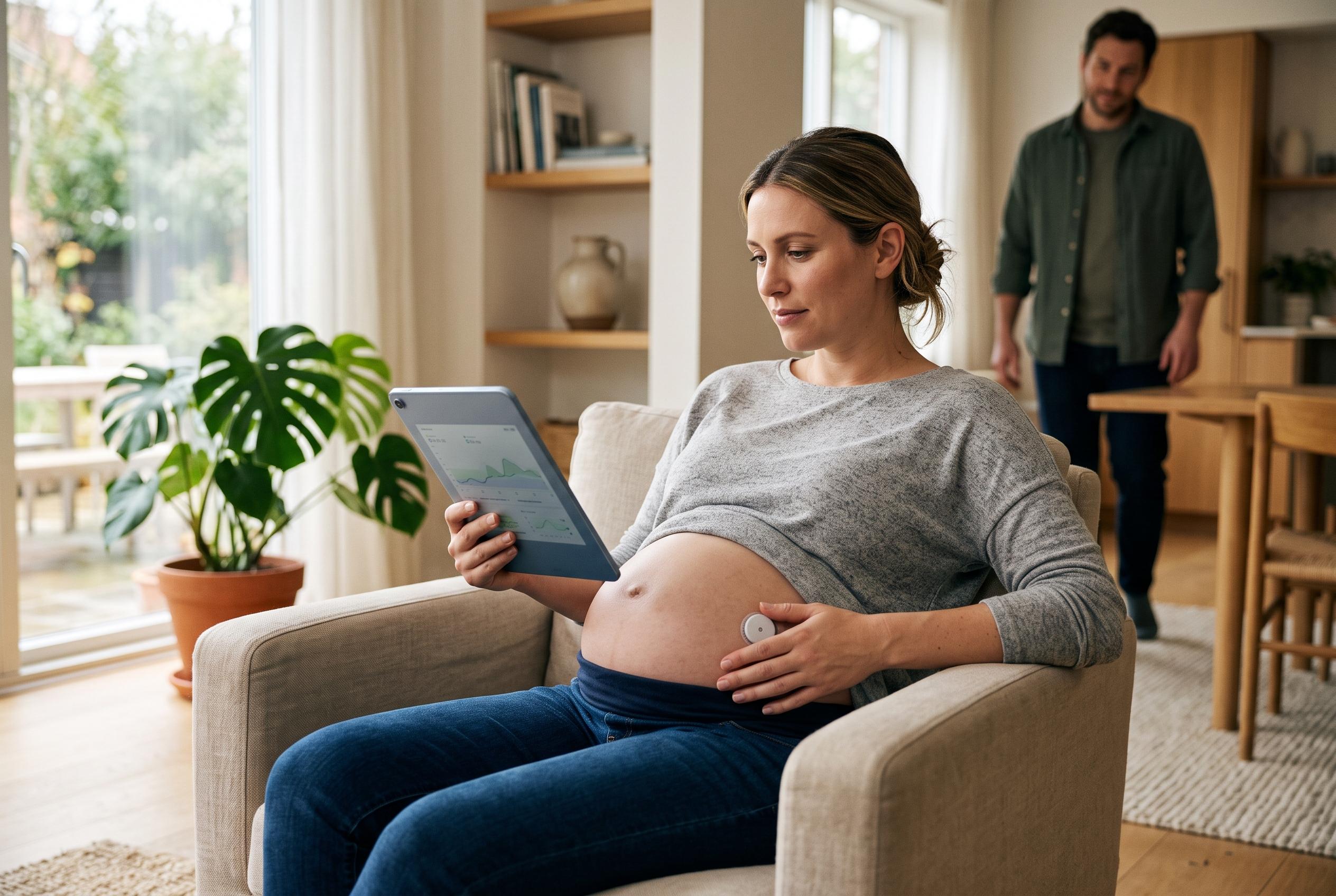

Emerging research underscores the benefits and limitations of continuous glucose monitoring in pregnant women, emphasizing cautious use and the importance of clinical judgement amidst ongoing technological improvements.
A finger-prick result in the normal range alongside a CGM reading in the 3s can feel alarming in pregnancy, but the evidence suggests it is neither rare nor necessarily a sign that either device has completely failed. What matters is that the mismatch tends to happen in the very part of the glucose range where pregnancy targets are tightest. In a 2023 head-to-head study of 42 women with hyperglycaemia in pregnancy, both the FreeStyle Libre Pro and Medtronic iPro2 became less reliable in the hypoglycaemic range, and the Libre Pro system underestimated glucose by an average of 1.09 mmol/L, enough to turn an acceptable capillary reading into an apparently worrying sensor low.
The basic reason is physiological rather than mysterious. A finger-prick meter measures blood glucose directly, while a sensor tracks glucose in interstitial fluid, which lags behind the bloodstream. A 2024 clinical review in Obstetrics & Gynecology said that lag, changing glucose levels and device-specific quirks all need to be considered before acting on a number. The same review also warned that some substances used in pregnancy can interfere with certain systems, including paracetamol and high-dose vitamin C, and said symptoms should take precedence when the reading does not fit the clinical picture.
That caution sits alongside more reassuring data. One of the main pregnancy validation studies, published in Diabetes Technology & Therapeutics in 2018, followed 74 pregnant women across 13 sites in the UK and Austria, including 39 with gestational diabetes, 24 with type 1 diabetes and 11 with type 2 diabetes. Two-thirds were using insulin. The researchers found an overall mean absolute relative difference, or MARD, of 11.8% for the FreeStyle Libre, with 99.8% of paired results landing in clinically acceptable Consensus Error Grid zones A and B. Participants also reported high satisfaction and there were no unanticipated device-related adverse events. But that is not the whole story for Libre in pregnancy. The later Indian comparison study found the professional, blinded Libre Pro performed materially worse than iPro2 overall, meeting ISO accuracy criteria in only 44.9% of values versus 88.5% for iPro2.
Dexcom’s newer pregnancy data look stronger, while still coming with caveats. A 2024 study of the Dexcom G7 enrolled 105 pregnant women with type 1, type 2 or gestational diabetes and analysed 96 sensors with evaluable accuracy data. Across 2,102 paired values, 92.5% met the study’s %20/20 agreement standard, and 99.8% fell within clinically acceptable error-grid zones. There were no serious adverse events, and the 10-day sensor survival rate was 90.3%. Even so, the first day stood out as weaker: only 78.6% of readings met the threshold on day one, compared with 96.3% on day four and 97.3% later in wear. Upper-arm placement also edged out abdominal wear.
That helps explain why diabetes teams still tell patients not to treat a surprising sensor low blindly. The Obstetrics & Gynecology review recommended checking a capillary reading first if a CGM alert is out of step with symptoms, especially when trend arrows are stable and the sensor and meter remain more than about 20-30 mg/dL, or roughly 1.1-1.7 mmol/L, apart. For devices that allow calibration, the authors said that persistent discrepancies can justify recalibration, but they warned against repeated adjustments. The same principle appeared in a 2025 randomised trial in gestational diabetes: participants using Dexcom G6 were instructed to confirm readings below 60 mg/dL or above 140 mg/dL with a capillary check.
That 2025 trial is important because it moved beyond accuracy and asked whether real-time CGM changes day-to-day management in gestational diabetes. In the single-centre study, published in Diabetes Care, 111 pregnant people with gestational diabetes were randomly assigned from February 2021 to June 2023 in a 2:1 ratio to either continuous Dexcom G6 plus capillary testing or capillary testing alone. The control group still underwent blinded CGM about every 20 days. Real-time CGM users spent more time in the target range of 3.3-7.8 mmol/L, had lower mean glucose and spent less time above range. Even so, the authors stopped well short of claiming proven newborn benefit, concluding that more studies were needed to show whether better glucose metrics translate into better perinatal outcomes.
The clearest pregnancy outcome evidence still comes from type 1 diabetes rather than gestational diabetes. In the CONCEPTT trial, published in The Lancet in 2017, researchers recruited women from 31 hospitals in Canada, England, Scotland, Spain, Italy, Ireland and the United States. Among 215 pregnant women with type 1 diabetes, CGM users spent more time in target, less time hyperglycaemic and had a small HbA1c advantage by 34 weeks. Their babies were less likely to be large for gestational age, less likely to need neonatal intensive care for more than 24 hours and less likely to develop neonatal hypoglycaemia, with hospital stays shortened by a day. The same paper found no apparent benefit in women who were only planning pregnancy, underlining how dependent CGM’s value can be on the clinical setting. The authors concluded that CGM “should be offered to all pregnant women with type 1 diabetes using intensive insulin therapy”.
For gestational diabetes, then, the picture is more practical than revolutionary. The 2024 Obstetrics & Gynecology review argued that CGM has become popular because it overcomes many of the limitations of repeated self-monitoring, particularly discomfort, inconvenience and the inability of finger-pricks to show overnight patterns or the shape of post-meal rises. But the same review said data remain limited for gestational diabetes and type 2 diabetes, even as use expands. Several of the key pregnancy studies also had manufacturer involvement: the 2018 Libre validation work was supported by Abbott Diabetes Care, while the G7 validation study and the 2025 Dexcom G6 trial were funded or supplied by Dexcom.
The practical takeaway is not that CGMs are untrustworthy, but that they are imperfect in recognisable ways. The low end of the range is a known weak spot. A brand-new sensor may be the least dependable one you wear. And when symptoms, timing and the sensor value do not add up, a well-done finger-prick remains the tie-breaker. For pregnant women, that is less a contradiction than the current state of the evidence: CGM can lighten the burden of constant testing and improve glucose visibility, but it still works best when used with judgement rather than on autopilot.
Disclaimer: This content is for informational purposes only and is not intended to be a substitute for professional medical judgment, advice, diagnosis, or treatment.