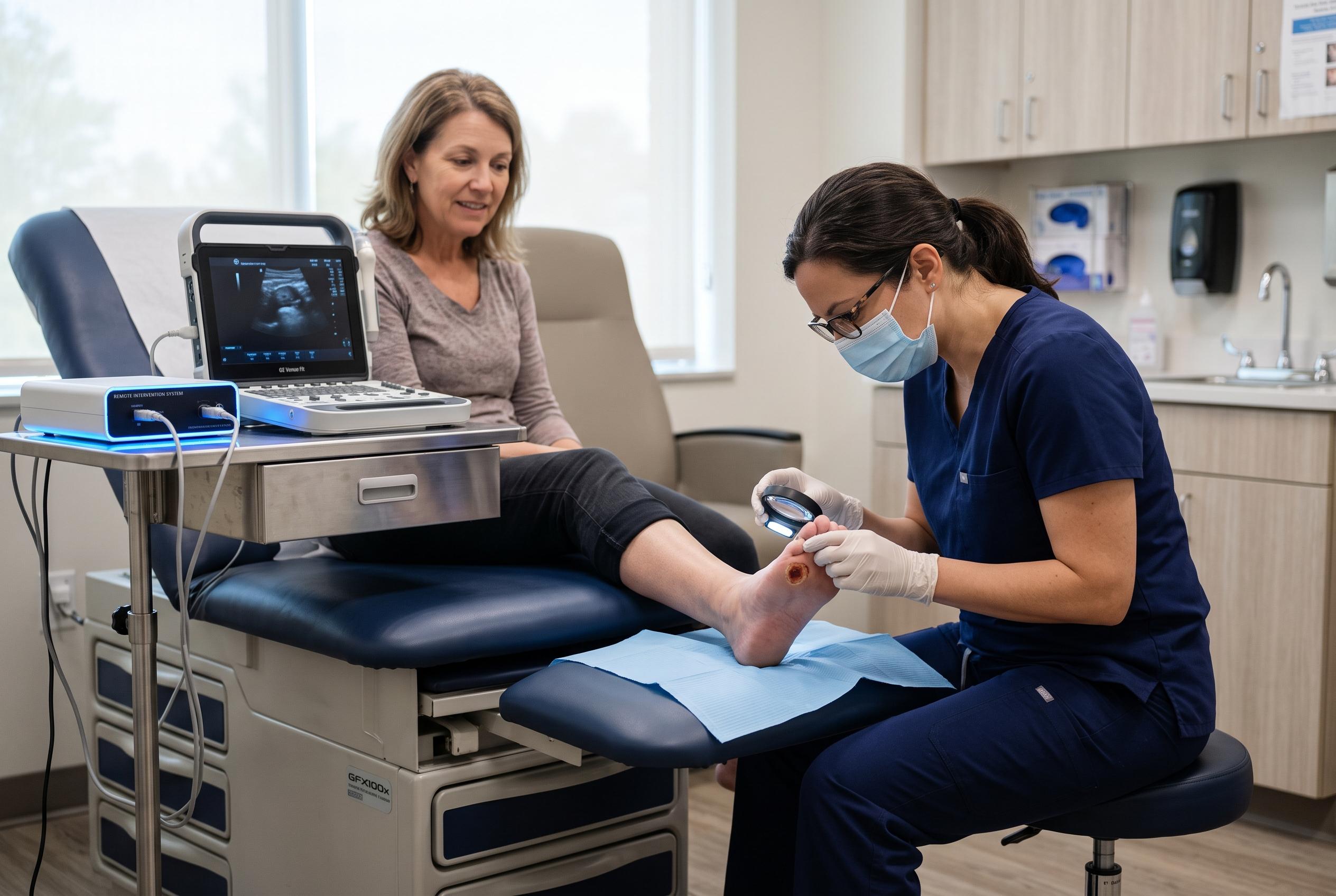

Emerging research suggests that treatments like spinal cord stimulation, ultrasound, and remote ischaemic conditioning may activate healing signals remotely, offering new hope for persistent diabetic foot ulcers where traditional methods fall short.
For people with diabetes whose foot ulcers persist despite dressings, debridement and vascular procedures, the next useful intervention may not touch the wound at all. A review in Burns & Trauma argues that several seemingly unrelated treatments, from spinal cord stimulation to ultrasound aimed at the spleen and even carefully staged surgery on the tibia, may work by setting off repair signals elsewhere in the body and improving blood flow, inflammation and healing in the threatened foot.
The paper, published on 8 April 2026 as a review rather than a clinical trial, traces an idea that had already been aired at SAWC Spring 2025 under the title “Spooky Action at a Distance”. By the time the full article appeared, the author list had expanded to include Ahmed Sami Raihane, Gabriela Morales Deusch, Charles Liu, Bijan Najafi, Wuquan Deng, Natasha G Dark and David G Armstrong, with affiliations spanning the University of New Mexico, USC, UCLA, Rancho Los Amigos, Pasadena City College and Chongqing University Central Hospital. The article is also archived in PubMed Central as an open-access paper, with the publication record showing it was received in August 2025, revised in February 2026 and accepted on 25 February.
That broader framing matters because the review is not really about a skin defect in isolation. The PubMed abstract says neuropathy and chronic limb-threatening ischaemia sharply raise the risk of lower-limb amputation as well as cardiovascular and cerebrovascular events. In the full-text archive, the authors place the problem in a global context, noting that diabetes is rising fastest in settings where specialist limb-preservation services are hardest to reach and where cheaper, scalable approaches would be most valuable.
The most mature evidence in the review concerns high-frequency spinal cord stimulation at 10 kHz, although even there the clearest data are on pain and nerve function rather than ulcer closure. In the SENZA-PDN programme cited by the authors, 79% of patients given spinal cord stimulation plus conventional medical management met the main pain and neurological endpoint, against 5% of those on medical treatment alone. Neurological improvement at six months was reported in 62% versus 3%. Those numbers suggest that neuromodulation may do more than blunt symptoms, but they still fall short of proving that implanted stimulators prevent amputation or heal hard-to-close ulcers.
Peripheral focused ultrasound remains further back in the evidence queue, yet it is one of the review’s more intriguing avenues because it aims to alter inflammation without surgery. The authors say splenic-targeted ultrasound appears to activate the cholinergic anti-inflammatory pathway and reduce pro-inflammatory signals including TNF-α, IL-1β and IL-6. Preclinical work cited in the paper reported that three-minute daily ultrasound sessions led to a 75% reduction in wound size four days faster than placebo in a diabetic ulcer model, while burn wounds closed up to 13 days earlier than controls. A pilot human study at the LA General Regional Burn Center enrolled 24 participants to test whether the same approach can safely improve healing, pain and quality of life.
Remote ischaemic conditioning is more prosaic but may be easier to scale. A Newswise syndication of the study highlighted the practical set-up shown in the paper’s diagram: typically four cycles of five-minute occlusion followed by five-minute reperfusion, often using a blood pressure cuff. The idea is to trigger systemic release of nitric oxide, cytokines and growth factors, improving endothelial function and microcirculation away from the compressed limb. In one double-blinded trial discussed in the review, 41% of treated patients achieved complete healing compared with none in the placebo group. In another study, 75.6% of wounds healed by week 20, compared with 36.6% under standard care.
The surgical limb-salvage techniques in the review are more invasive and more geographically concentrated, but they produced some of the most dramatic case-series results. Tibial transverse transport, adapted from the Ilizarov method, uses controlled distraction of a tibial bone window to stimulate periosteal activity, osteopontin signalling, the Orai1/STIM1 calcium pathway and nitric oxide production. One report cited by the authors found 100% wound healing in both arterial and non-arterial stenosis groups. In a 2021 study of 13 patients with Wagner grade 3 or 4 diabetic foot injuries treated with integrated surgical wound treatment, all wounds healed without amputation, with a mean healing time of 25.8 days and one nail-channel infection reported. A related method, lateral tibial periosteum distraction, was described in a 70-year-old smoker with chronic limb-threatening ischaemia whose ankle-brachial index improved from 0.5 to 0.9 and pain score from 9 to 1 after previous stenting and angioplasty had offered little benefit.
The review’s authors are careful not to oversell any of this. They say the field is still dominated by small studies, short follow-up, heterogeneous protocols and specialist centres, and Diabetic Foot Online’s discussion of the paper stressed the same point, noting the lack of robust long-term amputation-free survival data. The full-text article also spells out practical risks: lead migration and infection for spinal cord devices, pin-tract infection and prolonged discomfort for external fixation, and the simple fact that long-term safety for repeated ultrasound or repeated induced ischaemia remains poorly characterised. The research priorities set out in the paper call for multicentre randomised trials lasting at least 12 to 24 months, harmonised outcome measures, prospective safety registries and close attention to whether new techniques widen existing inequalities in access to limb care.
Since publication, the paper has been picked up not only by press-release services but by the specialist community it is trying to influence. The American Limb Preservation Society promoted it to its LinkedIn following as a five-modality framework for care delivered “far from the wound itself”, and that may be the most accurate way to view it for now: not as proof that standard practice should change tomorrow, but as a serious attempt to reorganise a scattered body of evidence around one central proposition. As the conference abstract put it last year, the therapies share “one unique unifying idea: creating a physiologic impact at a distance from the target”. Whether that idea becomes routine limb-preservation medicine will depend on evidence that does not yet exist.
Disclaimer: This content is for informational purposes only and is not intended to be a substitute for professional medical judgment, advice, diagnosis, or treatment.