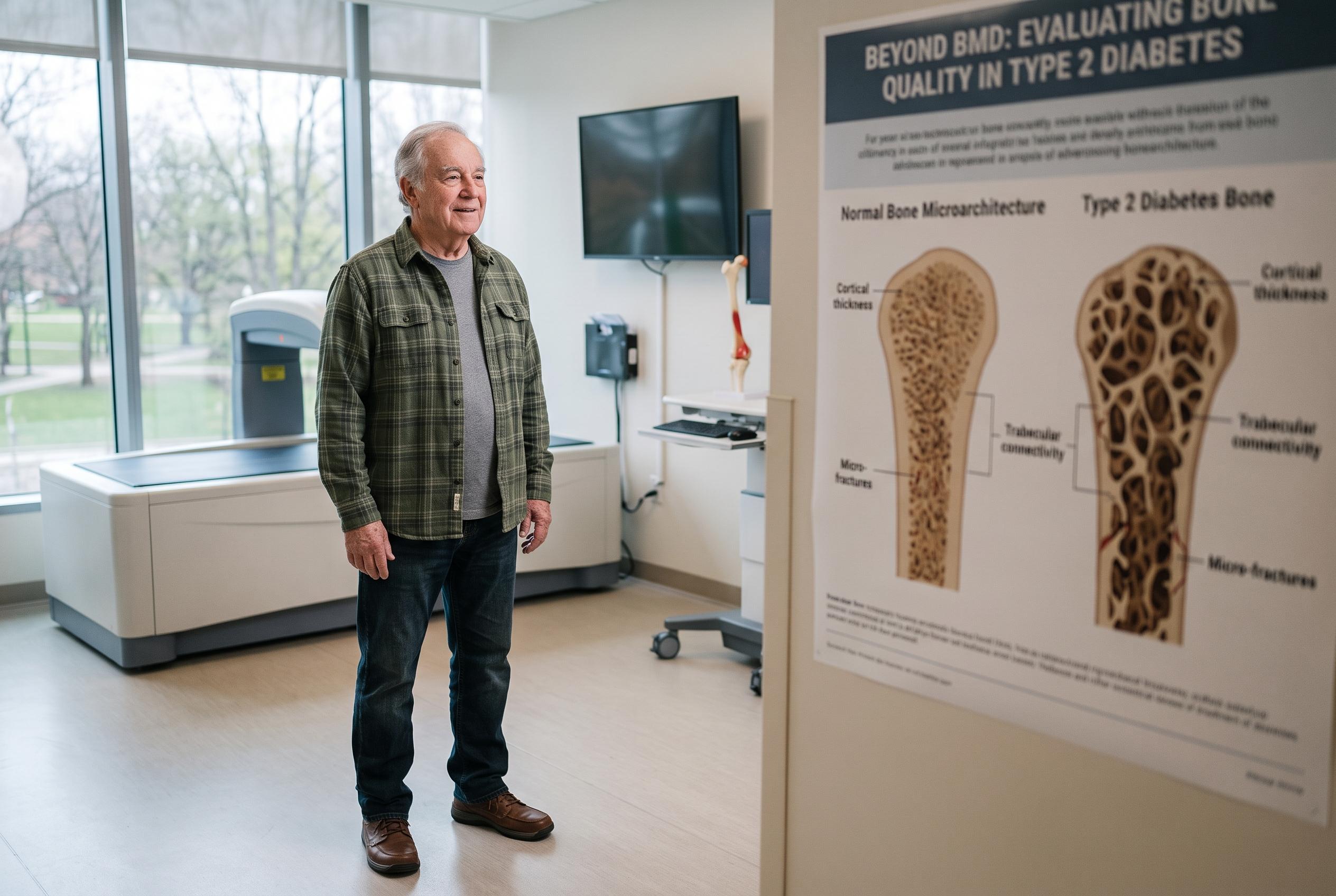

New research employing advanced imaging techniques finds that changes in both outer and inner bone structures contribute to higher fracture risks in older adults with type 2 diabetes, challenging reliance on bone density alone for risk assessment.
A new study in Diabetes Care suggests that the higher fracture risk seen in some older adults with type 2 diabetes cannot be explained by bone loss alone. Using advanced imaging in the Framingham Study, researchers found that changes in both the hard outer shell of bone and the spongy inner structure were broadly similar in older adults with and without diabetes, despite the well-known link between diabetes and fractures.
Lead author Alyssa B. Dufour, an associate scientist at the Hinda and Arthur Marcus Institute for Aging Research at Hebrew SeniorLife, said the team used a novel bone imaging device to examine bone quality in far greater detail than standard scans allow. The study focused on cortical bone, the dense outer layer, and trabecular bone, the internal lattice that helps give bone strength and resilience.
The result adds to a long-running puzzle in diabetes research. Earlier work has shown that people with type 2 diabetes can have higher bone mineral density, yet still face more fractures. A 2013 study found that poorly controlled diabetes was linked with higher bone density and thicker bone cortices, but that did not translate into protection against fractures. More recently, a 2024 analysis concluded that standard bone density scores may miss important parts of fracture risk in this population.
Other research points in the same direction. A 2017 high-resolution imaging study reported that older adults with type 2 diabetes had smaller bone cross-sectional area, lower cortical density and more porous cortical bone at the tibia than people without diabetes. Reviews published in 2024 also argued that fracture risk in diabetes varies over time and may depend in part on medication choice, while a 2019 meta-analysis found no clear evidence that SGLT2 inhibitors, a major class of diabetes drugs, worsened bone density or fracture risk.
Taken together, the latest findings reinforce the idea that doctors should not rely on bone density alone when assessing fracture risk in people with type 2 diabetes. As senior investigator Elizabeth Samelson noted, denser bones do not necessarily mean stronger bones. The challenge now is to identify the other factors, including changes in bone quality, falls risk and diabetes-related complications, that may help explain why fractures remain more common in this group.
Disclaimer: This content is for informational purposes only and is not intended to be a substitute for professional medical judgment, advice, diagnosis, or treatment.