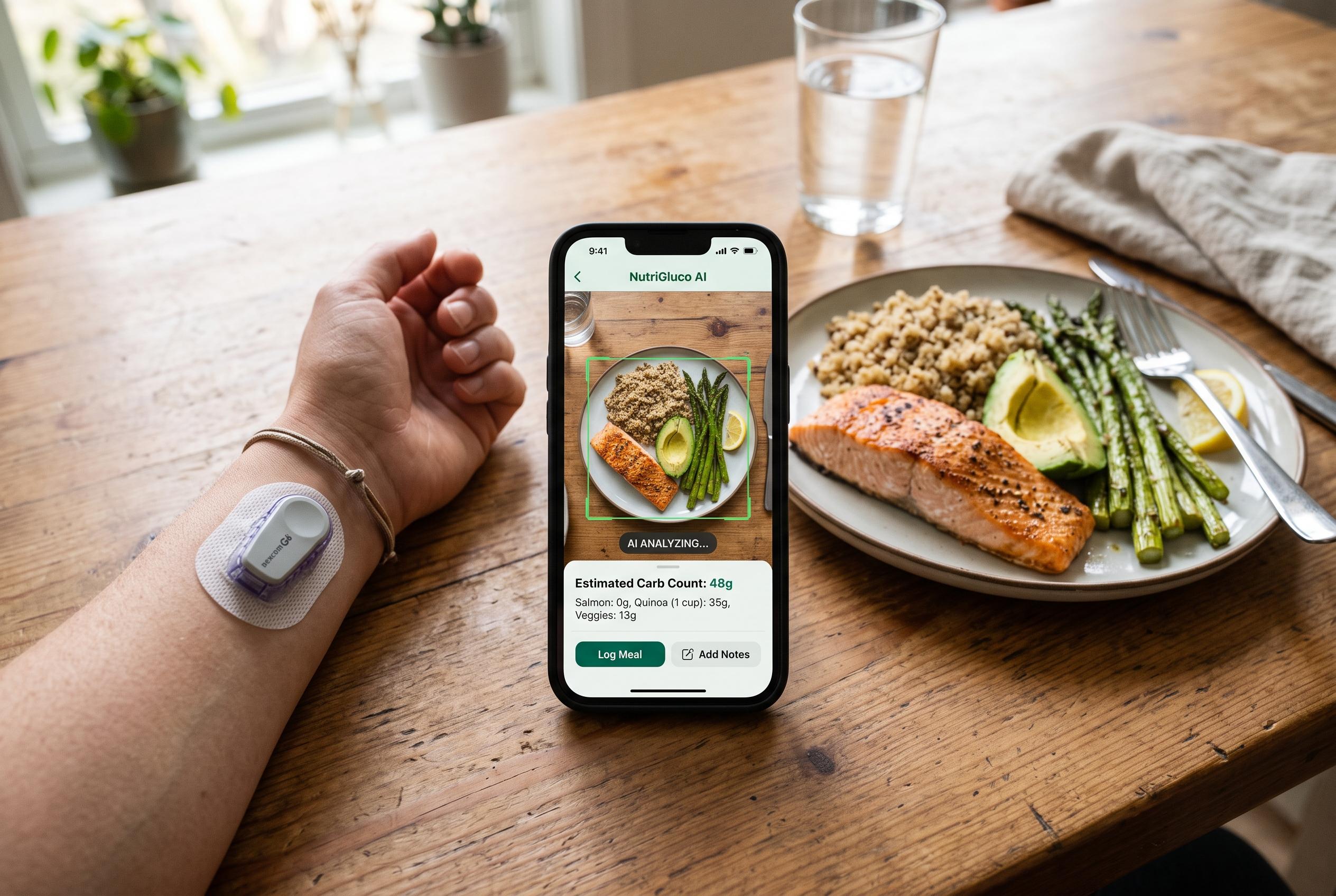

As diabetes apps attempt to automate carbohydrate counting through photos, experts warn that accuracy remains inconsistent. Meanwhile, the future lies in harnessing personal glucose data, raising urgent questions about data access and patient empowerment.
A growing cluster of diabetes apps now promises to estimate carbohydrates from a photograph of a meal, but the rush to automate dinner has not settled the harder question of whether those tools are accurate enough to trust. Studies published this year suggest the picture is more mixed than app store marketing implies: one evaluation found ChatGPT performed broadly in line with dietitians, while Gemini was more prone to sizeable overestimates; another bicentric study found ChatGPT came closest to clinicians under strict equivalence criteria, with other models such as Gemini and DeepSeek also within clinically acceptable limits. A separate review of app-assisted counting found these tools can reduce error, particularly with mixed dishes, but none of the research supports treating them as a substitute for judgement.
That broader debate is only part of the story. The deeper limitation, as the diabetes technology writer argues, is that nearly all of the effort so far has gone into the most visible task: identifying food on a plate. The more interesting opportunity lies in using machine learning to interrogate the data people already generate through continuous glucose monitors, insulin pumps and open-source closed-loop systems. In that view, the real breakthrough is not a camera that can guess carbohydrate grams, but a tool that can quickly test a hypothesis against years of personal data.
The examples are more ambitious than carb counting. Work described in open repositories examined smoothing algorithms for continuous glucose data, insulin action peak timing, simulation of real-world glucose traces and a digital twin approach aimed at replaying controller behaviour rather than pretending to predict a person’s biology. Another analysis revisited established rules of thumb such as the 1,700 and 500 rules, concluding that their traditional assumptions do not fit closed-loop users especially well. The writer’s central point is that these findings became possible because the cost of asking questions of large personal datasets has fallen sharply, not because the models themselves suddenly became wise.
That shift has a human cost. The article describes several instances in which apparently strong results were overturned only after positive controls exposed hidden flaws, including a model that seemed robust until it was tested against simulated data with a known answer. Another case involved a perfect recovery rate that turned out to be caused by a timestamp error, not by flawless reconstruction of insulin deliveries. The message is blunt: AI can accelerate analysis, but it also makes it easier to arrive at a confident mistake unless the researcher knows the domain well enough to challenge the answer.
The real bottleneck, the piece argues, is not coding but access. Community resources such as the OpenAPS Data Commons have made it possible for researchers to study real-world closed-loop use, but that archive reflects a narrow slice of people with diabetes: those who use open-source systems and are willing to share their data. Most commercial device data remain locked behind dashboards, PDFs or restricted partnerships, leaving patients unable to obtain complete, machine-readable records of their own treatment histories.
That is why the article gives unusual weight to the emerging diabetes data rights charter. According to the authors cited in The Lancet Diabetes & Endocrinology, people need real-time access to their data in a usable format, complete exports rather than partial portability, transparent rules on consent and a clearer account of where their data goes and how it is used. The case is not merely about research efficiency. It is also about empowering individuals to ask better questions of their own data, whether they are testing an insulin rule, checking a model or simply trying to make sense of a difficult week. The conclusion is less about artificial intelligence than about ownership, access and the quiet politics of who gets to ask the question in the first place.
Disclaimer: This content is for informational purposes only and is not intended to be a substitute for professional medical judgment, advice, diagnosis, or treatment.