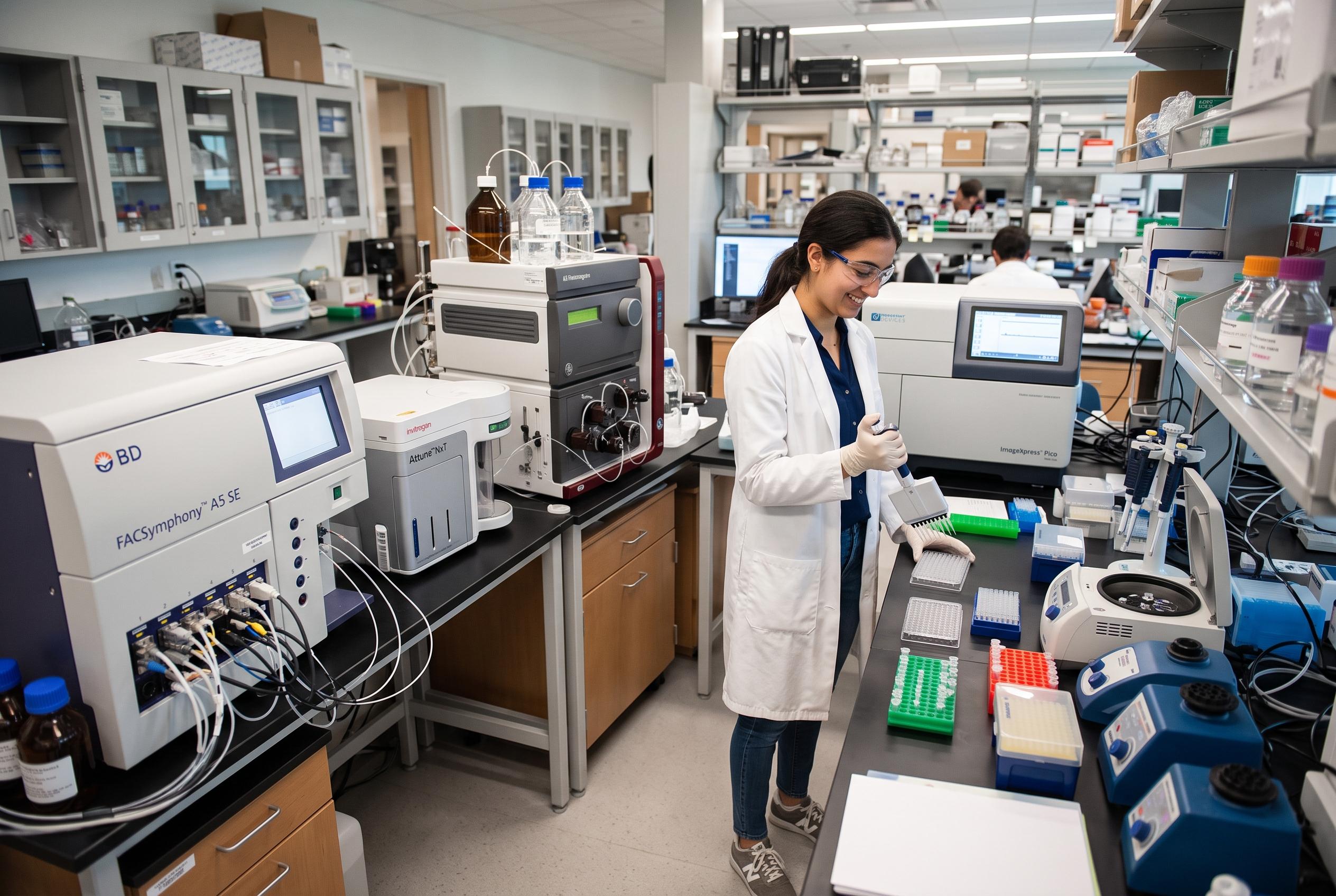

A Laidlaw research placement at Nexus and the Cheney Biomedical Accelerator has provided a student with new perspectives on metabolic disease, highlighting the importance of interdisciplinary tools like flow cytometry, high-throughput imaging, and protein analysis in understanding insulin resistance and diabetes.
Six weeks at the bench have brought a Laidlaw research placement to a close, but for the student behind the project, the final stretch has been as much about perspective as it has been about technique. Time at the Northern Cell Metrology Hub at Nexus provided a deeper look at flow cytometry and at how different experimental tools can illuminate different parts of the same biological problem. That wider view matters in metabolic research, where advances increasingly depend on combining imaging, molecular analysis and cell-specific measurements to understand disease in real time.
The placement also opened a window on future possibilities. A visit to the Cheney Biomedical Accelerator earlier in the summer left a strong impression, particularly because of its advanced imaging capabilities. High-throughput functional imaging has become an important way to study individual cells within mixed populations, allowing researchers to watch changes in metabolism, signalling and ionic activity as they happen. In the context of insulin resistance, that kind of approach can help reveal how disease develops in specific cell types rather than only in bulk tissue.
Much of the value of the project, however, appears to have come from the process of learning rather than from any single result. The student describes moving from hesitation in the laboratory to working independently with aseptic technique, Western blots, HUVECs, adipocytes, protein expression analysis, bioinformatics and scientific writing. That progression mirrors a wider truth about research: it rarely advances in a straight line. Experiments fail, assumptions change and new questions emerge, but those detours are often where the most useful problem-solving skills are formed.
The wider scientific context gives that experience added weight. Research into early-stage type 2 diabetes increasingly points to the value of proteomics, the large-scale study of proteins, in identifying biomarkers and pathways linked to glucose-insulin homeostasis. Recent studies have highlighted protein signatures associated with diabetes risk, as well as interactome mapping that shows how protein complexes are remodelled in insulin-resistant muscle. Other work has pointed to adipocyte-secreted proteins such as tetranectin as possible regulators of insulin secretion, suggesting new therapeutic targets and reinforcing the importance of understanding the disease at a molecular level.
For the student, that broader landscape has helped define what science means beyond one project. It is not just lab work, but also reading critically, communicating clearly, working across disciplines and thinking about how fundamental findings might eventually improve diagnosis and patient care. Although the summer placement has ended, the questions it raised and the confidence it built are likely to shape future work well beyond the degree itself.
Disclaimer: This content is for informational purposes only and is not intended to be a substitute for professional medical judgment, advice, diagnosis, or treatment.